Posts tonen met het label dung. Alle posts tonen

woensdag 4 januari 2017

Nachtspiegels

"Van schade by uytworpinghe",Joos de Damhoudere, Practycke ende handtbouck in criminele zaeken, Leuven, 1555,p.267
(Danny Lamarcq, Het latrinaire gebeuren-De geschiedenis van het W.C., Gent (Stichting Mens en Kultuur), 1993, p. 242)

"In het 16de-eeuwse [...] Antwerpen vaardigt het bestuur in 1561 het eerste stedelijk gebod uit op het ruimen van beerputten en een analoog gebod vinden we te Leuven in 1570. Het datzelfde jaar opgetekende Antwerpse gewoonterecht bepaalde dat wie in de stad een raam bijstak dat uitkwam op de buren, er tralies moest voor plaatsen zodanig "datmen thooft van eene volwasschen persoone, pispodt, noch dyergelijcke dingen daer nyet door en soude cunnen gesteken". Een decennium eerder stipuleert Joos de Damhoudere in zijn Practycke ende handbouck in criminele zaeken dat "wie vut zijn veinstere of duere worpt eenighe vulicheit, pisse of dier ghelycke op de ghemeene straete daermede hy de voorbyghanghers bonnette oft tabbaert oft ander cleeren vuyl maeckt oft bederft," boete dient te betalen." (Danny Lamarcq, Het latrinaire gebeuren - De geschiedenis van het W.C., Gent (Stichting Mens en Kultuur), 1993, p. 69)


Aardewerken kamerpotten gevonden in Mechelen: 203. Bolvormig type met hoge hals, lage schouder en nauwe opening, eind 15de-begin 16de eeuw, 204. Bolvormig type met trechtervormige hals, 16dde-begin 17de eeuw, 205. Kamerpot met bedpanallure, 16de eeuw (verzameling en foto's Mechelse Vereniging voor archeologie) (Danny Lamarcq, Het latrinaire gebeuren - De geschiedenis van het W.C., Gent (Stichting Mens en Kultuur), 1993, p. 242)

"In de zestiende eeuw werden de Zuidelijke Nederlanden geprezen om hun netheid. Vooral de Spanjaarden waren onder de indruk. De meerderheid van de straten van Antwerpen waren geplaveid met stenen. [...] Wat het gevoeg betrof, werd een zo zindelijk mogelijke oplossing gezocht. Zelfs de herbergen vielen hierbij niet uit de toon. De Beatis merkte op dat de kamers voorzien waren van koperen po’s die brandschoon zijn, in tegenstelling tot Frankrijk waar men ’s nachts en overdag in het vuur moet plassen.’" (Joey De Keyser, Vreemde Ogen: een kijk op de Zuidelijke Nederlanden, 1400-1600, Antwerpen (Meulenhoff/Manteau), 2010, p. 47-48)

maandag 11 juli 2016

Bread of Dreams - Digest: '9. Ritual Battles and Popular Frenzies'

"With unintentional but certainly bitter irony, many went on saying and repeating that the one and only treasure of the poor - the thesaurus pauperum - consisted in the maintenance of their health. None the less, many of the poor preferred sickness and death to a state of health which forced them to live an insufferable life and bear the intolerable torment of hunger. [...]
The medicina pauperum (medicine of the poor) attempted to apply inexpensive therapies which made use of preventive and curative remedies, the composition of which did not require rare and costly ingredients. On the one hand, the two-way medicinal path led to the complicated
and very expensive triaca (theriac) for the rich, believed to be a powerful remedy for almost all sicknesses, a universal panacea; and, on the other hand, to the 'theriac of the poor', composed only of herbs. For those with 'strong stomachs and used to hard work', like peasants and porters, the great preserver of health was garlic, the 'theriac of the rustic', suited to rough and work-weary people, those selected in reverse, from whom - according to the science of the time - could only be born rustic and obtuse offspring, since 'no son is born who does not obtain his quality and  temperament from the food which his father ate before he was conceived.' From this  presupposition, which seems to have been widely shared, it was deduced that

'the meat of the cow, steer and pig, the bread of red wheat, beans,
cheese, red wine and other heavy foods cause strong semen and bad
temperament: the son that is conceived will have great strength,
but will be wild and of animal wits. From this results that
among men of the countryside it would be a miracle if one turned
out to be of acute intelligence and prone to study, especially
where such coarse foods are eaten. The opposite occurs among citydwellers,
whose sons we see have more intelligence and ability. '
[Giuseppe Rosaccio, Fabrica universale dell'huomo sotto titolo di Microcosmo dichiarata 
(...) (Venice: G. Imberti, 1627), pp. 45-46]"

[Giuseppe Rosaccio (1530-1620), Italian geographer and physician (Wikimedia Commons, dd. 11/07/2016)]

"Fortunately for the peasants of the plain and the cacamarroni (literally, 'chestnut-shitters') of the mountains, popular medicine was less poisonous and probably more effective than the medicine of the rich. [...] The poor of the city, in fact, were very often forced to devour foods that were 'fetid, putrid and verminous ... [filled] even with mice, worms, snakes or other most disgusting and abominable animals'. " [Giulio Cesare Luigi Canali, La carità del prossimo celebrata, spiegata e promossa in più ragionamenti [...], Bologna: Gaspare de Franceschi, 1763, (ch. 5, n. 3), II, p. 32]

"'Plenty' was the great absentee; rare were the days when songs could be sung to praise its return and the defeat of 'Famine' (a literary exercise as well, modelled on the very popular theme of the struggle between Carnival and Lent in which, as in all the forms deriving from folk rituals, archaic apotropaic virtues were obscurely presented). In 1597, Giulio Cesare Croce 

Giulio Cesare Croce 
[Giulio Cesare Croce (1550–1609) was an Italian writer, actor/producer of cantastoria [a theatrical form where a performer tells or sings a story while gesturing to a series of images: these images can be painted, printed or drawn on any sort of material] and enigma writer. He wrote more than 400 works in Italian and Bolognese dialect. To be a literary man in his period meant living at court, having patrons, or else being left to one's own devices for financial purposes. Croce was never a true literary man in the strictest sense of the word since he preferred laymen audiences to the court. In fact, he was principally a story teller and a blacksmith and most likely wrote for his own personal satisfaction. As such, his stories and inspiration come from the lower class, from the audiences at the market, who, if able to read, bought his works. This is in stark opposition to many contemporary authors who were inspired by the whims of their patrons. (Wikipedia, dd. 11/07/2016)]

- after the good summer harvest which seemed to spell an end to the seven years of tribulations during which he himself had been heavily hit [...] - exalted the return of plenty to Bologna, praising the vice-legate Orazio Spinola for his decisive and victorious intervention during the years of dearth. In the excited dialogue between Plenty and Famine, Spinola's intervention is described as fundamental to the safety of the community for which Croce presented himself as intermediary and spokesman: a bard assigned to the expression of the city's collective conscience. Victor at last, Plenty can let its ringing voice be heard:

A baker in front of his oven. From a 15th-16th century Book of Hours, attributed to Jean Bourdichon © Bibliothèque municipale de Lyon (Ms 5141, f. 11v-12).

'The bread has grown in size, just as your insolence
Had so lowered and diminished,
That with difficulty its presence was seen;
And if it was black, badly cooked and, worse, dense,
Now all the bakers have the order
To make it good, white, large and with care;
And all the granaries are wide open
And what was worth sixteen is now worth eight,
So that misers hang themselves from the pain;
Bread is no longer seen on display
Already spoiled, as it used to be,
But bright as snow, and well-baked;
The bean, which sat on the throne,
And which seemed like sugar to the artisans,
Is now little appreciated or valued;
Now, in these plains, thanks to God,
Goods abound, and all the countryside
Produces abundant grains in great plenty;
Such that Bologna will once again
Be glorious and great, and neither
Will there ever be heard laments and complaints:
Never more will there be seen atop the dung-heap
So many wretched, afflicted and lifeless people,
Wrapped up in the straw and refuse;
In the future, they will be strong men,
Proud and robust, they will gather vigour,
Not weak and half-dead like before;
A healthy colour will return to their faces,
Strength will be put back where it belongs,
And natural warmth to its rightful state... '

(Il solennissimo trionfo dell'Abbondanza, per la sua fertilissima entrata nella Città di Bologna; il di primo d'Agosto 1597. Con l'amaro pianto, che fà la Carestia, nella dolorosa sua partita, in Dialogo (Bologna: Gio. Battista Bellagamba, 1597), fols. 5r.-6v.)[e-book]


This portrait painted by Plenty corresponds to the octaves of Girolamo Accolti, the 'Allegrezza de' poveri sopra il crescimento del pane' (published in Rome and republished in Bologna: Vittorio Benacci, 1597) (Cheerfulness of the poor over the growth of the bread', in which is written 'Of wheat we have great plenty', octave 1,5), and 'Il gran lamento fatto da Nicolotto Fornar da Pesaro. Per non poter fare il pane piccolo e nero come prima. Con il grandissimo pianto della Carestia nell'uscir di Bologna' (Bologna: Vittorio Benacci, 1603) ('The great lament made by Nicolotto Baker of Pesaro. Of not being able to make the bread small and black as before. With the very great weeping of Famine on leaving Bologna'. Newly composed by Alessandro de' Monti),

'Since the bread has increased in size,
White and beautiful and even well-baked,
Fancy breads, twice baked,
And no one can be satisfied.
We poor bakers.
Scottish-style and side-table breads,
With the finest flour,
From evening to morning
We are forced to make... (fol. 1 v.)
Even the husk and the pollard
Are not sold, but are thrown away... (fol. 2r.)'

The bakers, much hated by the poverelli ('little poor') and singled out by everyone as profiteers and creators of hunger, frequently saw their shops attacked and plundered by the mob. Together with the usurers and tax collectors they were the first to face the popular fury, as in the attack on the oven of the Gasse district of Bologna in August, 1677.
[...]
The popular furore had entered some time ago into the 'museums' of realistic literature, whether it examined the immense reservoir of human activities and appearances with regard to trades and professions, or specialized in the typological analysis of the various faces of famine. In this excited atmosphere of social tensions, uprisings and looting, it is not surprising that G. B. Segni rifled a page by Garzoni  [Giovanni Garzoni (1419–1506) was an Italian humanist and physician from Bologna, where he was professor of medicine and teacher of rhetoric  (Wikipedia, dd. 11/07/2016)] (even more sensational plagiarism was committed with casual frequency during a century when copyright was an unknown expression), replacing it in a real-life scenario of social disorder and disintegration, even though it remains essentially an exemplum: a rhetorical model of the abstract theme of human frenzy.
Whoever would like to see the misery of this present famine and starvation in its most wretched form should go to certain cities and lands that are tyrannized, where the taxes could not be higher, and see bread put in the warehouses and storerooms which is as black as coal or as grey as a donkey's hide, and of such a mixture that even hearty eaters could not stand it, and so small it seems like the balls of zarabottana, and so expensive that those responsible are wished a thousand evils, and sold with such an appearance that it seems to come from the executioner's hand, and so often contested that clubs, daggers and pikes are necessary in order to possess it, and brought out in such low quantities that many poor families die from hardship and hunger, cursing the traitorous usurers, the villainous rich and the murderous tax-collectors who are to blame for such a wicked and cruel famine. He would then hear all the people scream; he would see the common people rioting, with good reason; the poor crying into the wind; the peasants from outside claiming greater power; the hospitals filling up; the doors of the rich echoing with miserable voices; the square full of acts of rage; the warehouses and storerooms surrounded by calamitous and unhappy people; the earth crying out and the air sighing, the sky weeping for so much dearth and such an unbearable famine. He would witness many thefts, much stealing, much plundering of granaries, many virgins raped for a piece of bread; many husbands become voluntary scoundrels for a penny, that he would recognize as true the saying of Regnicolo Foretano, 'In times of famine due to lack of bread, there is no better foodstuff than human flesh.' What Quintilian also meant when he said 'Non habitant simul pudor et fames' ['Shame and hunger do not dwell together']. He would see many rich people murdered, so much clashing of arms that everything would exhaust itself. The customs-houses would be ransacked, the warehouses emptied, the banks broken into, the bakers beaten or pilloried, or forced to walk the rope in public, or hanged by the neck, for behaving like gluttons and scoundrels. 
[Giovan Battista Segni, Trattato sopra la carestia e fame, sue cause, accidenti, provisioni e reggimenti, varie moltiplicazioni, e sorte di pane. Discorsi filosofici, (Bologna: Gio. Rossi, 1602)]
(Camporesi 1996, '9. Ritual Battles and Popular Frenzies', pp. 103-107)


zondag 19 juni 2016

Bread of Dreams - Digest: '6. The World Turned Upside Down'

"If winter was always very difficult for the poor, existence became all the more trying in the years of famine, and the most defenceless found themselves 'lying on the ground, poor and wretched'. They sought refuge inside the straw, on refuse and manure. Tormented by chilblains, racked by coughs, infested by lice and ringworm and emanating intolerable smells - wandering dung-heaps, who in 'their own dung even grow fat / I as if they were beetles or worms', unsatiated stomachs 'where the dung both leaves and enters' (Baldassare Bonifacio) - they slowly came back to life when the warm weather arrived and the pangs of hunger lessened; famine seemed in retreat. The exultation of the survivors fed the unjustified illusions of future health, strength and vigour. The discouraging images of prostration and starvation were put away." [...] The resurrection of the famished beggars - the 'half dead' with ashen and dried-out skin - and the abandoning of the bed of dung and the wrapping of straw, indicated the first part of a return to a more humansocial dimension. [...] The disasters of a hunger epidemic, of a seven-year famine (like the one which raged in much of northern Italy between 1590 and 1597), left marks too profound to be wiped out from one day to the next. [...] The accelerated deterioration of physical and mental health during the years of stupefying starvation was for many people an irreversible process towards intellectual disorderand degradation that the return to 'normal' - to the low level of daily undernourishment - would not succeed in wiping out."
(Camporesi 1996, '6. The World Turned Upside Down', pp. 78-79)

"The image of the world, seen from below, appears uncertain, flawed, ambiguous, unbalanced and unhomogeneous, as in the visions of the drugged and the possessed. [...] The natural and divine order is broken up and altered: chaos takes priority over a rational design that presupposes a centre towards which the whole immense periphery converges in unity. The 'expanded conscience' overflows everywhere. The same articulation of time changes the frame of reference:
'time outside of time' is posed as the anti-model of 'time that is within time'. The progressive is nullified in the regressive.
The city of Balordia (literally, 'folly'), kingdom of the idle, lives in a mythology of ebb and flow, unanchored in historical time. This compensatory dream projected from the popular utopia conquers ever more extensive territories in which 'superior' rationality no longer finds a place. [...]
The pauper/slacker lives in the 'time of laziness': the metahistorical time of predictability and insecurity institutionalized in security, set loose from working time, the risk of the future and the fear of history.


Bruegel, Het Land van Kokanje (Luilekkerland), 1567,  olieverf op paneel52 x 78 cm, Bayerische Staatsgemäldesammlungen, Alte Pinakothek, München, inv. 8940

The 
Land of Cockaigne, in the drugged logic of the impossible, becomes a driving image, able to penetrate the mental cosmos in which the natural (and the real) have been supplanted by the artificial and the unreal. In this dream universe, the mechanical and physical laws no longer make sense: macaroni falls from heaven like edible rain; the earth, no longer worked, miraculously produces pre-cooked foods; the trees do not toss down buds and leaves, but hams and clothes; the animals, their own butchers, spontaneously roast themselves for the comfort of men's stomachs. Work is abolished, time suspended, fatal old age staved off by the fountains of youth, and the women, in their bodily splendour, are triumphant over their straddled and subjected husbands.
But this dismal land of idleness - from which risk has been banished, untouched by the storms of history, without fear and without future - appears sunk in a perspective that is not only dream-like but positively funereal, in a world where plenty is reflected in the negative face of sterility: where nature, overturned, forms inhuman and monstrous landscapes, beyond every possible logic and far from every perspective of life. A 'nature' where the artificial has destroyed the natural, turning it upside down, altering its biological laws, the periods for the maturation of produce and even the time of animal gestation. [...]
(Camporesi 1996, '6. The World Turned Upside Down', pp. 79-80)

"Poverty and madness eventually coincide, in the way that the face of a child struck by athrepsia (a diseased condition caused by malnutrition), undernourishment or the mal dal simiot ('monkey disease', as it was known in Modena), his worn-out skin all wrinkled, appeared similar to that of an old senescent monkey.
The double face of puer/senex, dear to the mystic religions, was utilized at the popular level as the concrete image of the overturning of the natural order. The tiny malnourished senescent was placed on a baker's peel, put in the lukewarm oven and taken out three times with the incantation:

'Into the oven you go, and out
you come, so that the monkey
may remain inside.'

The ambiguous, enigmatic, entangled and reversible logic of popular mental stereotypes presents itself as a cultural anti-model which, because of its subtle attraction, also contaminates the rationalistic Aristotelian culture. In the folk vision of the world, preceded by ingenious anachronism, space is presented as a dimension of time and the universe as a place of ordered chaos where the possible and the impossible dwell together in the same percentage of probabilities. Time is either still or is measured with the unabstract metre of sweat and toil. The land that can be ploughed with a pair of oxen from dawn to sunset becomes a day: a unit of time substitutes for a unit of surface area. The years are counted in terms of empty and full, the seesaw of famine and plenty. The 'year of hunger' is placed in the centre of the calendar of the poor. The 'longest day' is the one during which one does not eat. Time becomes an expandable and shrinkable variable, articulated by the stomach's pulsations, the gut's thinning out or filling up and the fatigue of labour. The popular ceremonial of eating also reproposes a different use of time, alternating long days of the most frugal nourishment - a regimen of survival bordering on starvation - with interminable ritual excesses, dietary orgies and colossal feasts, disorder and drunkenness quite different from the noble banquet based entirely on the aesthetic values of food, a visual cuisine to be displayed."
(Camporesi 1996, '6. The World Turned Upside Down', p. 82)

"It is in this social panorama, traversed by profound anxieties and fears, alienating frustrations, devouring and uncontrollable infirmities and dietary chaos that adulterated and stupefying grains contributed to delirious hypnotic states and crises, which could explode into episodes of collective possession or sudden furies of dancing. The forbidden zones, those most contaminated by the ambiguous, ambivalent magic of the sacred, seemed to emanate perverse influences and unleash dark energies. Psychological destitution, together with the torment of an ailing body, acted as detonator of the epileptic attacks and tumultuous and surging group fits, in which men were attracted and repelled by centres of powerful fascination and places of sacrifice, like the altar. The pathological trance into which entire groups fell [...] forms the alarm call originating from a feverish world: a social body altered in its physiological and psychic equilibrium, where 'marvel' could be confused with 'miracle', which in its turn could appear as 'trickery', 'enchantment' or 'diabolical invocation'.
The horrible dances of the sick inside churches, where the troubled presence of the contaminated and the impure was united with the consecrated and the supernatural, resulted in spectacular, bewildering performances. [...]"
(Camporesi 1996, '6. The World Turned Upside Down', pp. 83-84)

"At Ferrara in 1596, according to the Modenese chronicler Giovan Battista Spaccini, it is believed that the cause of many illnesses, of which numerous people even die, is the bad breads which the people eat, namely that of beans, cabbage and plain oil'. (G. B. Spaccini, Cronaca modenese (1588-1636), ed. G. Bertoni, T. Sandonnini and P.E. Vicini (Modena: Ferraguti, 1911), I, p. 38)
The dark spectre of food poisoning and the crisis (even fatal) of 'evil' breads weighed heavily on
the cities of the Duchies and Papal Legations. Because of the criminal intervention of cynical speculators, 'vulgar' bread could sometimes hide destructive traps. Or else, as happened at Modena in 1592, it could lead to a dangerous slide into the dull and delirious senselessness of intoxification.
Adulterated breads had been put into circulation by the untori of the Public Health: criminal attacks orchestrated by the 'provisionary judges' who were supposed to oversee the well-balanced  provisioning of the public-square.

'On the 21st, a Sunday, with Monday approaching, Master ...
[blank in the manuscript] Forni, Judge of provisions in the square
of Modena, was arrested, along with the bakers, for having had
forty sacks of bay leaf ground to be put in the wheat flour to make
bread for the square, where it caused the poverty to those who
bought it to worsen, so that for two days there were many people
sick enough to go crazy, and during this time they could not work or
help their families.'  (Spaccini, Cronaca modenese, I, pp. 3-4)"

(Camporesi 1996, '6. The World Turned Upside Down', pp. 84-85)

"Temporarily losing their reason or permanently weltering in hunger, many peasants preferred to leave home and turn to begging rather than helplessly witness their children's agony. Changed into a 'house of death', the hut becomes a murderous trap and tomb for the least protected:

'a few days ago [April 1601] in the town of Reggio . . . a peasant,
along with his wife, so as not to see their three sons perish from
hunger in front of their eyes, locked them in the house and set out in
the name of heaven. After three days had passed the neighbours,
not having seen them, decided to knock down the door, which they
did. And they found two of the sons dead, and the third dying with
straw in his mouth, and on the fire there was a pot with straw inside
which was being boiled in order to make it softer for eating.'
(Spaccini, Cronaca modenese, II (1919), p. 117)"

(Camporesi 1996, '6. The World Turned Upside Down', p. 85)


vrijdag 26 februari 2016

Bread of Dreams - Digest: '5. 'They Rotted in Their Own Dung''

Giulio Cesare Luigi Canali (1690-1765), parish piest of Sant' Isaia (Bologna), "knew from close range the drama of the 'stomach of the poor': of their flesh, pierced by the chill and hollowed out by ringworm and lice [...]"
"This curate, who lived in such painfully close contact with mendicity, also serves as a precious guide [...], shining the ray of his lantern's light on the most secret aspects of the beggars' lives. He also illuminates the insomnia of the poor, the recurrent and almost obsessive theme of stench, fetor, rags and lurid scarred flesh ('with foul sores, seething throughout the body') [...] and the subject of dirty underpants: [...] who could exaggerate the discomforts of the rubbish, the stench, the emaciation and the squalor whilst these paupers are forced to wear the same underpants for months and months? What Capuchin's most hirsute sackcloth, what penitent's roughest hairshirt, in comparison to these underpants, should not rather be considered the finest linen and delicate sea-silk, particularly given the insufferable troubles that this causes, sordidness which, so to speak, generates rotten flesh. [...] The images which the implacable eye of the Bolognese curate forces us to smell more than observe, are those of the hell of the poor: a putrefied inferno, foul with bodily waste, stagnant faeces and decomposing urine. [...]

Whether in the gloomy interiors of their tumble-down hovels ('the shacks, hay-lofts, caves, dungeons, muddy pools, the semi-infernos of the paupers. Oh, spectacles of compassion and horror!' exclaims Canali, 'How many times I nearly fainted for the intolerable stench and fetor! '), or in the total inferno of the prisons, perceived, carnally and viscerally, as the 'universal punishment of all the senses', where the nauseating perception of stench and fetor which impregnates everything dominated obsessively, yet again.
That filth and those faeces, in which it is their need to swim and remain immersed, so that the prison nearly becomes a sewer! What tongue and what ink would suffice to describe the pain that they bear above all, that they would sooner lie on thorns or burning coals than on that rubbish? And yet they are seen reduced to such intolerable extremes of misery, that they could fit almost to the
letter the words of Joel: 'the beasts of burden rotted in their own dung'.
The descent into the depths could not fail to pass through the 'dismal, frightening spectacle' of the hospital: 'theatre of horror', 'residence of tears', 'home of spasms', 'dark region of death: in regione umbrae mortis'. They stagnate in gloomy corridors, where the 'miserable diseased incurables
... the helpless poor', lie amidst the 'stench and horror of their own disgusting sores'.

Stench and fetors assault the sense of smell, screams and laments the hearing, squalid and deformed faces under one's eyes. Some, because of burning fevers, rave and throw whatever is handy; others, also because of fevers, but of opposite type, shiver and clatter their teeth. Some have their heads split by unbearable headaches, others have their ribs broken and guts pierced by acute pleurisy. One who is about to be suffocated by excessive catarrh, and another who thinks a thousand times he is about to die from the incessant attacks of bad asthma, but never dies. There, as a result of a most bitter thirst, one suffering from dropsy struggles impatiently, and here, because of intestinal inflammation, a consumptive is heard to come to his end [...] There are the convulsions and the contractions of the nerves, [...]; there are aqueous hernias, false catarrhs, fistulated sores, tumours of such large size that there is no medicine other than iron and fire (...) so that, doing the necessary both with iron and with fire, in a metamorphosis that is too difficult but otherwise inevitable, the infirmaries become Calvaries, the beds gallows, the doctors ... executioners."
(Camporesi 1996, '5. 'They Rotted in Their Own Dung'', pp. 68 - 70)

"Strange priests wandered among the pallets of the dying, the attendant fathers of the sick, called fathers 'of Good Death': '[...] Sinister. black as crows, disliked by the sick, they tried to convince them that since diseases were none other than 'a royal road to show us the way to heaven so as to rejoice
in the Divine Essence, they should not decline our attention nor regret it, but should accept and endure with holy will. Better dead but saved than vagabond and sinner, was their logic. In many the 'holy will' was late in showing itself, and this was a shame, because in fact the diseases could
'take away the opportunity of falling into some very grave sin' [Marcello Mansi in the Consigli per aiutare al ben morire (1625)]."
(Camporesi 1996, '5. 'They Rotted in Their Own Dung'', p. 70)

"The 'poveretti' emerge from the silence of nothingness thanks to the mediation of story-tellers such as Giulio Cesare Croce, Vincenzo Citaredo of Urbino, author, among other works, of the Speranza de' poveri (1588), and Giacomo Cieco Veronese [Lamento nuovo sopra la andata di Tofalo zafo Sbirro de poveri mendichi casa bella e ridicolosa (1593)], and many others, often anonymous.Among the latter there is the author of the Opera nuova. Dove si contiene il lamento della Poverta, sopra la carestia dell'anno 1592, in which the anxiety about bread that 'is in size / like a bird's egg', the feeling of being 'poor creatures' in the hands of monopolizers and usurers, powerless and wretched [...], is moderated by the acceptance of the unavoidable fatality of famine sent to those with 'evil phalluses', and in homage to the established powers. [...] The entire poem is punctuated by this obsessive call to patience and forbearance, the exhortation to be suspicious of false prophets and professional troublemakers, the shuddering call to the great journey to Kingdom of Shadows, the appearance of old late-medieval motifs and the re-emergence of death's lugubrious triumphs."
(Camporesi 1996, '5. 'They Rotted in Their Own Dung'', p. 71)

"The opinion that famine and plague were signs of divine wrath, caused by the corrupt and wicked habits of men was widespread. Many held that famine was brought  about by natural causes like the 'irregularity of the weather and the altered seasons' , but most, uninfluenced even by the political side of the unequal distribution of resources, believed that it was divine anger which punished excesses, 'debauchery, discord and lust'.A good portion of the population swore that it was not the 'corruption' of the air, 'the putrefied inferior elements', the eating of 'rotten fish', the action of 'wicked ministers' in the service of the Turk, or the coming and going of 'merchandise', but the angel of the angered God which generated the scourge.

The Bolognese druggist Pastarino was firmly convinced of of this. In his Preparamento ... per medicarsi in questi sospettosi tempi di peste [1577], while he noted the frequent outbreak of the plague in the 'two most mercantile cities of Italy', he swore that the 'many iniquities ... that are performed in transactions, dealings and trading moves God to send some of his terrible scourges and, in particular, pestilence'.
Both herb vendor and preacher, he exhorted his fellow-citizens to dry out 'this our body full of grease and humidity'. This is in accordance with Galen's precept, 'It is proper to dry up the body in this way, and keep it dry', and reinforced by the authority of Avicenna, according to whom 'The best treatment of them [those ill with... pestilential fevers] is desiccation, and it is best that their foods be dried.' Preacher of sobriety and abstinence ('one lives better with little), this singular and ambiguous spice merchant - citing Galen ('it is proper to open up the blocked pores') - called for the opening up of the soul before the body.
'And what are these blocked pores if not our own ears, deaf to sermons, and our mouths, closed to confessions? These should be opened, because by doing so the infirmities are discovered, the bad
humours are revealed, we recognize our worst qualities and, better, they are more easily restored to health ... Having done this, it is necessary to conclude with a good evacuation and make every effort
to evacuate all the superfluities that are within us. Thus we have the rule given to us by Galen that 'convenit corpus superfluitatibus plenum evacuare'. And Avicenna as well ... used these words: 'Purging and loosening is very useful as is the evacuation of the stomach in treating the plague'.
Let us now accept as a principle, my fellow-citizens, to evacuate from this our body every superfluity that is found here. Superfluous are the evil thoughts, dishonest reasoning and wicked designs that
occupy the mind. Superfluous are the lascivious glances, malicious signs and curiosities that dominate the eyes. Superfluous are vain things ... superfluous swearing . . . Superfluous are the things of others that we wrongly keep. And superfluous is still all that with which we could help the poor but do not ... Let us therefore protect ourselves from divine anger, and with this complete evacuation of the body . . . let us prepare to treat ourselves. '
It is not easy to say how much the voice of this Bolognese druggist was heard, seemingly bizarre in the play of extravagant comparisons between apothecary culture and pastoral ideology."
(Camporesi 1996, '5. 'They Rotted in Their Own Dung'', pp. 72-73)

"The elettuario de sanguinibus ('blood electuary') was a speciality of Pastarino's shop, to which the Senate of Bologna had conceded the privilege of publicly preparing, on the second day of August, the antidotes with which the city,[...] prepared for the 'defence' of its citizens as if for soldiers 'enclosed in a strong and well-fortified castle', in order to resist the attack of diseases.
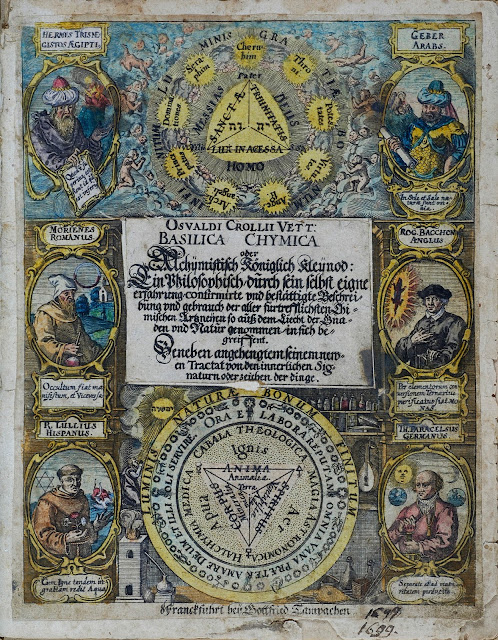
Osvaldus Crollius, Basilica Chymica, Chemical Heritage Foundation, Public Domain


Ludovico Locatelli, Theatro d'Arcani, 1644 edition

The turnover of cash around the druggists' shops was considerable. It is known that two pharmacopoeias existed, one for the rich - full of expensive rarities like 'ambergris', 'bezoar-stone', 'unicorn stone', rubies and gold - and one for the poor, much more modest, almost entirely vegetable. The Fabrica de gli spetiali by Prospero Borgarucci (1566), Valerio Cordo's Dispensarium (1554), Johann Schroeder [1600-1664]'s Thesaurus pharmacologicus, Osvaldus Crollius [1563 - 1609]' Basilica chymica and Ludovico Locatelli's Theatro d'arcani [1644], presupposed buyers with unlimited available finances."
(Camporesi 1996, '5. 'They Rotted in Their Own Dung'', p. 73)


Ambergris

[Ambergris: "a solid, waxy, flammable substance of a dull grey or blackish colour produced in the digestive system of sperm whales. [...] Ambergris has been mostly known for its use in creating perfume and fragrance much like musk. Perfumes can still be found with ambergris around the world. It is collected from remains found at sea and on beaches [...] During the Black Death in Europe, people believed that carrying a ball of ambergris could help prevent them from getting the plague. This was because the fragrance covered the smell of the air which was believed to be a cause of plague. This substance has also been used historically as a flavoring for food and is considered an aphrodisiac in some cultures. During the Middle Ages, Europeans used ambergris as a medication for headaches, colds, epilepsy, and other ailments." (Wikipedia, dd. 26/02/2016)]


Elephant bezoar


Unknown, Goat bezoar, 16th century, Wien, Kunsthistoriches Museum (Kunstkammer)

[Bezoar: " a mass found trapped in the gastrointestinal system (usually in the stomach); Bezoars were sought because they were believed to have the power of a universal antidote against any poison. [...] In 1575, the surgeon Ambroise Paré described an experiment to test the properties of the bezoar stone. At the time, the bezoar stone was deemed to be able to cure the effects of any poison, but Paré believed this was impossible. It happened that a cook at King's court was caught stealing fine silver cutlery and was sentenced to death by hanging. The cook agreed to be poisoned instead. Ambroise Paré then used the bezoar stone to no great avail, as the cook died in agony seven hours later. Paré had proved that the bezoar stone could not cure all poisons as was commonly believed at the time. 
Modern examinations of the properties of bezoars by Gustaf Arrhenius and Andrew A. Benson of the Scripps Institution of Oceanography have shown that they could, when immersed in an arsenic-laced solution, remove the poison. The toxic compounds in arsenic are arsenate and arsenite. Each is acted upon differently, but effectively, by bezoar stones. Arsenate is removed by being exchanged for phosphate in the mineral brushite, a crystalline structure found in the stones. Arsenite is found to bond to sulfur compounds in the protein of degraded hair, which is a key component in bezoars." (Wikipedia, dd. 26/02/2016)]


Unicorn Horn / Narwhal tooth
[Unicorn stone: probably "'unicorn horn' [also known as an alicorn], is a legendary object, [...] many healing powers and antidote's virtues were attributed to the horn of the unicorn. These properties, assumed real since the 13th century, made it one of the most expensive and most reputable remedies during the Renaissance, and justified its use in royal courts. Beliefs related to the "unicorn horn" influenced alchemy through spagyric medicine. The horn's purification properties were eventually put to the test in, for example, the book of Ambroise Paré, Discourse on unicorn [...] Seen as one of the most valuable assets that a king could possess, unicorn horns were exchanged and could be purchased at apothecaries as universal antidotes until the 18th century. [...] The legendary unicorn was never captured, but its symbolic association with virginity made it the symbol of the incarnation of God's Word, innocence and divine power. Belief in the power of the unicorn's horn and its origins persisted from the Middle Ages to the 18th century, when the true source, the narwhal, was discovered. This marine mammal is the true bearer of the "unicorn horn", actually an extended tooth found in the mouth of males and some females." (Wikipedia, dd. 26/02/2016)]


woensdag 24 februari 2016

Bread of Dreams - Digest: '1. The 'Disease of Wretchedness''

"'One was really tired of being in the world,' noted a French rural curate in his diary during the seventeenth century, interpreting the desperation of the most wretched parishioners who died of hunger in his village. At the beginning of the same century a Bolognese canon, Giovan Battista Segni, recalled that 'in Padua in 1528, every morning throughout the city twenty-five or thirty dead from hunger were found on dungheaps in the streets. These paupers did not even resemble men.'
A terrible passage, coming from one of the most learned cities in Europe, that ominously illuminates the last stage in a troubled metamorphosis: the long miserable voyage towards the destruction of what is human and the passing birth of the man/animal in daily contact with dung, attracted by the mirage of its soothing, fermenting heat. A nauseating refuge for whoever was forced to sleep naked on excrement, like a second Job. [...]
The urban scene then came to resemble terrifying concourse - to use an image dear to a classical writer on hunger, St Basil - traversed by spidermen, skin dried out and ashen, eyes sunken in hollowed-out bony sockets like the kernels of dried nuts. St Basil's 'Homilia dicta tempore famis et siccitatis' painted a masterly portrait of these starving men which would remain an inimitable model until the time when famine stopped tormenting the West."
(Camporesi 1996, '1 The 'Disease of Wretchedness', pp. 26-27)

"In representing the hell of the poor one constant motif is used: the physical degradation of the starving pauper and his bestial metamorphosis. The pages written by doctors and priests often give us passages describing the collective reality with strong and biting dramatic force. Those who daily moved among the hungry and the dying were - more efficaciously than the men of letters (involved in totally different excercises) - the best interpreters and witnesses of the dismal marasmus of wretched individuals and crowds. Their voices agree in underlining the intolerable filth of the beggars, the nauseous and disagreeable stink of poverty, inescapable companion of the 'canine' condition: They did not have the appearance of humans, writes a south Italian doctor during the eighteenth century, 'so haggard and thin were they, and, furthermore, they stank so badly that when approaching citizens or wandering through the streets or churches or public spaces, they caused instantaneous giddinessand dizziness'."
(Camporesi 1996, '1 The 'Disease of Wretchedness', pp. 33)