Posts tonen met het label stench. Alle posts tonen

donderdag 26 mei 2016

Bread of Dreams - Digest: '7. 'Famine of Living' and 'Times of Suspicion''

"the micro-society of the family [...] explodes like a crazed cell[:]
Aberrant frenzies ignited by hunger [dissolve] every emotional and social bond.
'Hunger is crueller than the plague, because man is in need for much more time, but the plague is more abominable because as soon as it gives us time to catch our breath, it takes away our memory, removes every thought of repentance, and causes the confessors to be absent; the notaries no longer come to write the testaments, the doctors flee, the fathers are sick and tired of their sons, who turn their backs on their fathers, the mothers abandon their daughters and they shun their mothers, one relative does not recognize the other, friends become enemies.'
[Giovan Battista Segni, Discorso sopra la carestia, e fame (Ferrara: B. Mamarello, 1591), p. 46]

The testaments to which Segni refers pertain to the death ritual of the rich: they were the 'passports to the world beyond' (Jacques Le Goff) which foresaw vast endowments to churches and convents, so that the dying passed away with a peaceful conscience, socially and religiously relieved of every  misdeed. The poor amused themselves, in the absence of goods and the difficulties arising because of them, by enacting parodies of testaments, in order to laugh a little at this act sacred to the religion of things'"
(Camporesi 1996, '7. 'Famine of Living' and 'Times of Suspicion'', pp. 87-88)


Anonymus, s.n., 1578, schilderij, Leuven, Sint-Jacobskerk
"Une intense agitation s'observe devant l'église : des prêtres en surplis sortent pour aller donner la communion aux malades et aux mourants; des tombes sont hativement creusees dans l'enclos paroissial, autour des cercueils prêts ii à y être enfouis. Une charrette passe dans la rue, chargée de cercueils ; à droite, un malade est conduit en chaise au lazaret; au premier plan, un cadavre presque nu a été jeté dans une fosse béante, hors de la terre consacrée de la paroisse; au coin de l'enclos, un oratoire abrite !es statues de saint Sébastien et de saint Roch devant lesquelles un couple prie. Cette toile (véritable instantané pris sur le vif) illustre le moment où la mortalité croit tellement qu'il ne sera bientôt plus possible d'enterrer !es morts individuellement : ils seront alors déversés, sans même un linceul, dans des fosses ouvertes n'importe oú." (Jacqueline Brossollet et Henri Mollaret, Pourquoi la peste? le rat, la puce et le bubon (Découvertes Gallimard Sciences), Paris (Gallimard), 1994, pp. 42-43


"The strong passions of the heart, ruling Contagion, can be called the first grave-diggers of man. All the doctors proclaim with one voice that especially Rage, Melancholy, and Terror are cause for flight as much as the Plague itself . . . Thucydides recounts that in the very serious plague which he describes, the melancholic and fearful fell dead more than the others. Various doctors have observed likewise in their own times, and among others Sennerto attests that not a few have been taken by this disease from just the Terror conceived observing from afar, or even without seeing but only hearing that the funeral Cart was passing under their windows, on which were carried the corpses of the dead.
Others, frightened only by a funereal Dream, have so lost heart that, once fallen ill, they have eluded all treatment ... Once the imagination is wounded and the spirits and humours put into disordered
movement by some frightening spectacle, the pestilential poison is all too easily taken, and even without the plague people sometimes die of pure Consternation and Black Humour."
[L.A. Muratori, Li tre governi, politico, medico ed ecclesiastico, utilissimi, anzi necessari in tempo di peste, 3rd edn (Milan: Vigoni & Cairolo, 1721), p. 119] (Camporesi 1996, '7. 'Famine of Living' and 'Times of Suspicion'', p. 89)


Pieter Bruegel, Triomf van de dood [detail], 1562, schilderij, 160 x 120 cm, Madrid, Prado

"But in times of Suspicion - when one hears of 'cases of the plague far away, yes, but which necessitate the precautions of health observances, and of railings or gates, when one must force out of the City as from the State, within a few days, the beggars, vagabonds, gypsies, mendicants, lepers, invalids and similar sorts of people not engaged in some trade and without the will to procure their bread, if not by the all too comfortable begging for it' [Muratori, Li tre governi, p. 23] - the entire variegated universe of those on the margins of society, always and everywhere watched with suspicion and fear, became the potential vehicle of contagion and carrier of epidemics. And on the twelfth day of May, 1498, the Officials of Disease went around the hospitals, chased [them]  out [...], and wherever they were found throughout the city they sent them out of Florence.' [Luca Landucci, Diario fiorentino, dal 1450 al 1516, continued by an anonymus writer till 1542 (Florence: Sansoni, 1883), pp. 299-300] The pestilential disease reaped most of its victims from among the poorest people - labourers, small artisans[...]; among those who did not have the necessary means to leave the inhabited centres rapidly."

'Where the cities are of a large population and the families, mostly of the poor, live in close and crowded houses, the plague causes incredible slaughter . . . [F]or this reason in the quarters most
crowded and overflowing with poor inhabitants, when the disease has entered therein, a frightening desolation is seen in a short time. ' [Muratori, Li tre governi, p. 23] The conditions of those who were forced by indigence to remain in the city [...] became most difficult; the 'poor people' risked 'the manifest danger of dying then from hunger and hardship' [Muratori, Li tre governi, p. 22]: [...]
the poor of the city are without those people who could give them alms or provide them with work, and as a result every day they receive less from the granary and storehouse, so that they remain exposed to the daily risk of dying from hunger, not less than that of the plague. [Muratori, Li tre governi, p. 25]


Anonymus (German), 16th century, woodcut. © Bildarchiv Preußischer Kulturbesitz / Jörg P. Anders

"In the 'afflicted city', dominated by the nightmare of the 'lazaret/slaughter house', [Muratori, Li tre governi, p. 96] smokey and malodorous from the vapours of sulphur, pitch, animals' horns (especially birds' beaks), old shoes, hair, nails and cattle manure, 'it is too easy for one to lose courage and die of fear, on seeing and hearing the ministers of the lazarets and grave-diggers go around with  horrible faces, odd clothes and frightening voices and carry away the sick and the healthy, the dead and the living, as long as there is something to pilfer. Nor can it be said what horror is inspired by the frequent  sound of their bells. ' [Muratori, Li tre governi, p. 97]


Johannes De Ketham, Fasciculus Medicine Antwerpen, Antwerpen (Claes De Grave), 1512
2 personnages sluiten hun neus af, de dokter draagt een spons, gedoopt in azijn
 om de veronderstelde geïnfecteerde lucht te filteren

In a world where the sad winds of Insecurity, Fear and Suspicion blew, the terror of the plague - multiplying the 'antidotes', internal and external 'preservatives', 'pouches', and 'amulets of arsenic', poisonous or innocuous - had as an unfailing consequence the realization of the 'great Chaos of Pharmaceutical Preservatives'. In this dance of prescriptions containing arsenic, sublimate, quicksilver, and of 'curative or preservative aromatic pouches', magic, superstitious practices and apotropaic astrology re-emerged - if ever they had been renounced - with unusual popularity and desperate impetus. The 'archaic attitudes' of the popular world and the magical base of its culture
shattered even the inconsistent rational barriers of a medical science more unsteady and contradictory than ever, groping in the dark.
'The astrologers and the superstitious have inverted many seals, medals, bulletins, rings, cards and similar things with figures, signs, numbers and even sacred words. Some, and mostly in Germany,
exalt and call a marvellous preservative the wearing of a dried toad hung from the neck - or burned and reduced to ash and enclosed in a pouch - during times of contagion. Others in the same manner recommend the wearing of Quicksilver, well closed and sealed with wax inside a walnut ... and they tell of its wonderful effect. According to others, Emerald, Sapphire, Hyacinth and other gems hung from the neck, in such a way that they touch the external regions of the heart, so frightens the plague that it dares not approach.' [Muratori, Li tre governi, p.128]
(Camporesi 1996, '7. 'Famine of Living' and 'Times of Suspicion'', pp. 89-91)

vrijdag 26 februari 2016

Bread of Dreams - Digest: '5. 'They Rotted in Their Own Dung''

Giulio Cesare Luigi Canali (1690-1765), parish piest of Sant' Isaia (Bologna), "knew from close range the drama of the 'stomach of the poor': of their flesh, pierced by the chill and hollowed out by ringworm and lice [...]"
"This curate, who lived in such painfully close contact with mendicity, also serves as a precious guide [...], shining the ray of his lantern's light on the most secret aspects of the beggars' lives. He also illuminates the insomnia of the poor, the recurrent and almost obsessive theme of stench, fetor, rags and lurid scarred flesh ('with foul sores, seething throughout the body') [...] and the subject of dirty underpants: [...] who could exaggerate the discomforts of the rubbish, the stench, the emaciation and the squalor whilst these paupers are forced to wear the same underpants for months and months? What Capuchin's most hirsute sackcloth, what penitent's roughest hairshirt, in comparison to these underpants, should not rather be considered the finest linen and delicate sea-silk, particularly given the insufferable troubles that this causes, sordidness which, so to speak, generates rotten flesh. [...] The images which the implacable eye of the Bolognese curate forces us to smell more than observe, are those of the hell of the poor: a putrefied inferno, foul with bodily waste, stagnant faeces and decomposing urine. [...]

Whether in the gloomy interiors of their tumble-down hovels ('the shacks, hay-lofts, caves, dungeons, muddy pools, the semi-infernos of the paupers. Oh, spectacles of compassion and horror!' exclaims Canali, 'How many times I nearly fainted for the intolerable stench and fetor! '), or in the total inferno of the prisons, perceived, carnally and viscerally, as the 'universal punishment of all the senses', where the nauseating perception of stench and fetor which impregnates everything dominated obsessively, yet again.
That filth and those faeces, in which it is their need to swim and remain immersed, so that the prison nearly becomes a sewer! What tongue and what ink would suffice to describe the pain that they bear above all, that they would sooner lie on thorns or burning coals than on that rubbish? And yet they are seen reduced to such intolerable extremes of misery, that they could fit almost to the
letter the words of Joel: 'the beasts of burden rotted in their own dung'.
The descent into the depths could not fail to pass through the 'dismal, frightening spectacle' of the hospital: 'theatre of horror', 'residence of tears', 'home of spasms', 'dark region of death: in regione umbrae mortis'. They stagnate in gloomy corridors, where the 'miserable diseased incurables
... the helpless poor', lie amidst the 'stench and horror of their own disgusting sores'.

Stench and fetors assault the sense of smell, screams and laments the hearing, squalid and deformed faces under one's eyes. Some, because of burning fevers, rave and throw whatever is handy; others, also because of fevers, but of opposite type, shiver and clatter their teeth. Some have their heads split by unbearable headaches, others have their ribs broken and guts pierced by acute pleurisy. One who is about to be suffocated by excessive catarrh, and another who thinks a thousand times he is about to die from the incessant attacks of bad asthma, but never dies. There, as a result of a most bitter thirst, one suffering from dropsy struggles impatiently, and here, because of intestinal inflammation, a consumptive is heard to come to his end [...] There are the convulsions and the contractions of the nerves, [...]; there are aqueous hernias, false catarrhs, fistulated sores, tumours of such large size that there is no medicine other than iron and fire (...) so that, doing the necessary both with iron and with fire, in a metamorphosis that is too difficult but otherwise inevitable, the infirmaries become Calvaries, the beds gallows, the doctors ... executioners."
(Camporesi 1996, '5. 'They Rotted in Their Own Dung'', pp. 68 - 70)

"Strange priests wandered among the pallets of the dying, the attendant fathers of the sick, called fathers 'of Good Death': '[...] Sinister. black as crows, disliked by the sick, they tried to convince them that since diseases were none other than 'a royal road to show us the way to heaven so as to rejoice
in the Divine Essence, they should not decline our attention nor regret it, but should accept and endure with holy will. Better dead but saved than vagabond and sinner, was their logic. In many the 'holy will' was late in showing itself, and this was a shame, because in fact the diseases could
'take away the opportunity of falling into some very grave sin' [Marcello Mansi in the Consigli per aiutare al ben morire (1625)]."
(Camporesi 1996, '5. 'They Rotted in Their Own Dung'', p. 70)

"The 'poveretti' emerge from the silence of nothingness thanks to the mediation of story-tellers such as Giulio Cesare Croce, Vincenzo Citaredo of Urbino, author, among other works, of the Speranza de' poveri (1588), and Giacomo Cieco Veronese [Lamento nuovo sopra la andata di Tofalo zafo Sbirro de poveri mendichi casa bella e ridicolosa (1593)], and many others, often anonymous.Among the latter there is the author of the Opera nuova. Dove si contiene il lamento della Poverta, sopra la carestia dell'anno 1592, in which the anxiety about bread that 'is in size / like a bird's egg', the feeling of being 'poor creatures' in the hands of monopolizers and usurers, powerless and wretched [...], is moderated by the acceptance of the unavoidable fatality of famine sent to those with 'evil phalluses', and in homage to the established powers. [...] The entire poem is punctuated by this obsessive call to patience and forbearance, the exhortation to be suspicious of false prophets and professional troublemakers, the shuddering call to the great journey to Kingdom of Shadows, the appearance of old late-medieval motifs and the re-emergence of death's lugubrious triumphs."
(Camporesi 1996, '5. 'They Rotted in Their Own Dung'', p. 71)

"The opinion that famine and plague were signs of divine wrath, caused by the corrupt and wicked habits of men was widespread. Many held that famine was brought  about by natural causes like the 'irregularity of the weather and the altered seasons' , but most, uninfluenced even by the political side of the unequal distribution of resources, believed that it was divine anger which punished excesses, 'debauchery, discord and lust'.A good portion of the population swore that it was not the 'corruption' of the air, 'the putrefied inferior elements', the eating of 'rotten fish', the action of 'wicked ministers' in the service of the Turk, or the coming and going of 'merchandise', but the angel of the angered God which generated the scourge.

The Bolognese druggist Pastarino was firmly convinced of of this. In his Preparamento ... per medicarsi in questi sospettosi tempi di peste [1577], while he noted the frequent outbreak of the plague in the 'two most mercantile cities of Italy', he swore that the 'many iniquities ... that are performed in transactions, dealings and trading moves God to send some of his terrible scourges and, in particular, pestilence'.
Both herb vendor and preacher, he exhorted his fellow-citizens to dry out 'this our body full of grease and humidity'. This is in accordance with Galen's precept, 'It is proper to dry up the body in this way, and keep it dry', and reinforced by the authority of Avicenna, according to whom 'The best treatment of them [those ill with... pestilential fevers] is desiccation, and it is best that their foods be dried.' Preacher of sobriety and abstinence ('one lives better with little), this singular and ambiguous spice merchant - citing Galen ('it is proper to open up the blocked pores') - called for the opening up of the soul before the body.
'And what are these blocked pores if not our own ears, deaf to sermons, and our mouths, closed to confessions? These should be opened, because by doing so the infirmities are discovered, the bad
humours are revealed, we recognize our worst qualities and, better, they are more easily restored to health ... Having done this, it is necessary to conclude with a good evacuation and make every effort
to evacuate all the superfluities that are within us. Thus we have the rule given to us by Galen that 'convenit corpus superfluitatibus plenum evacuare'. And Avicenna as well ... used these words: 'Purging and loosening is very useful as is the evacuation of the stomach in treating the plague'.
Let us now accept as a principle, my fellow-citizens, to evacuate from this our body every superfluity that is found here. Superfluous are the evil thoughts, dishonest reasoning and wicked designs that
occupy the mind. Superfluous are the lascivious glances, malicious signs and curiosities that dominate the eyes. Superfluous are vain things ... superfluous swearing . . . Superfluous are the things of others that we wrongly keep. And superfluous is still all that with which we could help the poor but do not ... Let us therefore protect ourselves from divine anger, and with this complete evacuation of the body . . . let us prepare to treat ourselves. '
It is not easy to say how much the voice of this Bolognese druggist was heard, seemingly bizarre in the play of extravagant comparisons between apothecary culture and pastoral ideology."
(Camporesi 1996, '5. 'They Rotted in Their Own Dung'', pp. 72-73)

"The elettuario de sanguinibus ('blood electuary') was a speciality of Pastarino's shop, to which the Senate of Bologna had conceded the privilege of publicly preparing, on the second day of August, the antidotes with which the city,[...] prepared for the 'defence' of its citizens as if for soldiers 'enclosed in a strong and well-fortified castle', in order to resist the attack of diseases.
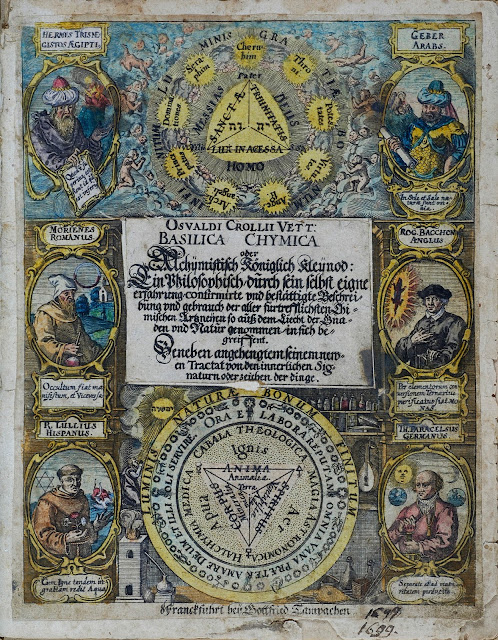
Osvaldus Crollius, Basilica Chymica, Chemical Heritage Foundation, Public Domain


Ludovico Locatelli, Theatro d'Arcani, 1644 edition

The turnover of cash around the druggists' shops was considerable. It is known that two pharmacopoeias existed, one for the rich - full of expensive rarities like 'ambergris', 'bezoar-stone', 'unicorn stone', rubies and gold - and one for the poor, much more modest, almost entirely vegetable. The Fabrica de gli spetiali by Prospero Borgarucci (1566), Valerio Cordo's Dispensarium (1554), Johann Schroeder [1600-1664]'s Thesaurus pharmacologicus, Osvaldus Crollius [1563 - 1609]' Basilica chymica and Ludovico Locatelli's Theatro d'arcani [1644], presupposed buyers with unlimited available finances."
(Camporesi 1996, '5. 'They Rotted in Their Own Dung'', p. 73)


Ambergris

[Ambergris: "a solid, waxy, flammable substance of a dull grey or blackish colour produced in the digestive system of sperm whales. [...] Ambergris has been mostly known for its use in creating perfume and fragrance much like musk. Perfumes can still be found with ambergris around the world. It is collected from remains found at sea and on beaches [...] During the Black Death in Europe, people believed that carrying a ball of ambergris could help prevent them from getting the plague. This was because the fragrance covered the smell of the air which was believed to be a cause of plague. This substance has also been used historically as a flavoring for food and is considered an aphrodisiac in some cultures. During the Middle Ages, Europeans used ambergris as a medication for headaches, colds, epilepsy, and other ailments." (Wikipedia, dd. 26/02/2016)]


Elephant bezoar


Unknown, Goat bezoar, 16th century, Wien, Kunsthistoriches Museum (Kunstkammer)

[Bezoar: " a mass found trapped in the gastrointestinal system (usually in the stomach); Bezoars were sought because they were believed to have the power of a universal antidote against any poison. [...] In 1575, the surgeon Ambroise Paré described an experiment to test the properties of the bezoar stone. At the time, the bezoar stone was deemed to be able to cure the effects of any poison, but Paré believed this was impossible. It happened that a cook at King's court was caught stealing fine silver cutlery and was sentenced to death by hanging. The cook agreed to be poisoned instead. Ambroise Paré then used the bezoar stone to no great avail, as the cook died in agony seven hours later. Paré had proved that the bezoar stone could not cure all poisons as was commonly believed at the time. 
Modern examinations of the properties of bezoars by Gustaf Arrhenius and Andrew A. Benson of the Scripps Institution of Oceanography have shown that they could, when immersed in an arsenic-laced solution, remove the poison. The toxic compounds in arsenic are arsenate and arsenite. Each is acted upon differently, but effectively, by bezoar stones. Arsenate is removed by being exchanged for phosphate in the mineral brushite, a crystalline structure found in the stones. Arsenite is found to bond to sulfur compounds in the protein of degraded hair, which is a key component in bezoars." (Wikipedia, dd. 26/02/2016)]


Unicorn Horn / Narwhal tooth
[Unicorn stone: probably "'unicorn horn' [also known as an alicorn], is a legendary object, [...] many healing powers and antidote's virtues were attributed to the horn of the unicorn. These properties, assumed real since the 13th century, made it one of the most expensive and most reputable remedies during the Renaissance, and justified its use in royal courts. Beliefs related to the "unicorn horn" influenced alchemy through spagyric medicine. The horn's purification properties were eventually put to the test in, for example, the book of Ambroise Paré, Discourse on unicorn [...] Seen as one of the most valuable assets that a king could possess, unicorn horns were exchanged and could be purchased at apothecaries as universal antidotes until the 18th century. [...] The legendary unicorn was never captured, but its symbolic association with virginity made it the symbol of the incarnation of God's Word, innocence and divine power. Belief in the power of the unicorn's horn and its origins persisted from the Middle Ages to the 18th century, when the true source, the narwhal, was discovered. This marine mammal is the true bearer of the "unicorn horn", actually an extended tooth found in the mouth of males and some females." (Wikipedia, dd. 26/02/2016)]


woensdag 24 februari 2016

Bread of Dreams - Digest: '1. The 'Disease of Wretchedness''

"'One was really tired of being in the world,' noted a French rural curate in his diary during the seventeenth century, interpreting the desperation of the most wretched parishioners who died of hunger in his village. At the beginning of the same century a Bolognese canon, Giovan Battista Segni, recalled that 'in Padua in 1528, every morning throughout the city twenty-five or thirty dead from hunger were found on dungheaps in the streets. These paupers did not even resemble men.'
A terrible passage, coming from one of the most learned cities in Europe, that ominously illuminates the last stage in a troubled metamorphosis: the long miserable voyage towards the destruction of what is human and the passing birth of the man/animal in daily contact with dung, attracted by the mirage of its soothing, fermenting heat. A nauseating refuge for whoever was forced to sleep naked on excrement, like a second Job. [...]
The urban scene then came to resemble terrifying concourse - to use an image dear to a classical writer on hunger, St Basil - traversed by spidermen, skin dried out and ashen, eyes sunken in hollowed-out bony sockets like the kernels of dried nuts. St Basil's 'Homilia dicta tempore famis et siccitatis' painted a masterly portrait of these starving men which would remain an inimitable model until the time when famine stopped tormenting the West."
(Camporesi 1996, '1 The 'Disease of Wretchedness', pp. 26-27)

"In representing the hell of the poor one constant motif is used: the physical degradation of the starving pauper and his bestial metamorphosis. The pages written by doctors and priests often give us passages describing the collective reality with strong and biting dramatic force. Those who daily moved among the hungry and the dying were - more efficaciously than the men of letters (involved in totally different excercises) - the best interpreters and witnesses of the dismal marasmus of wretched individuals and crowds. Their voices agree in underlining the intolerable filth of the beggars, the nauseous and disagreeable stink of poverty, inescapable companion of the 'canine' condition: They did not have the appearance of humans, writes a south Italian doctor during the eighteenth century, 'so haggard and thin were they, and, furthermore, they stank so badly that when approaching citizens or wandering through the streets or churches or public spaces, they caused instantaneous giddinessand dizziness'."
(Camporesi 1996, '1 The 'Disease of Wretchedness', pp. 33)