Posts tonen met het label pharmacology. Alle posts tonen

maandag 11 juli 2016

Bread of Dreams - Digest: '9. Ritual Battles and Popular Frenzies'

"With unintentional but certainly bitter irony, many went on saying and repeating that the one and only treasure of the poor - the thesaurus pauperum - consisted in the maintenance of their health. None the less, many of the poor preferred sickness and death to a state of health which forced them to live an insufferable life and bear the intolerable torment of hunger. [...]
The medicina pauperum (medicine of the poor) attempted to apply inexpensive therapies which made use of preventive and curative remedies, the composition of which did not require rare and costly ingredients. On the one hand, the two-way medicinal path led to the complicated
and very expensive triaca (theriac) for the rich, believed to be a powerful remedy for almost all sicknesses, a universal panacea; and, on the other hand, to the 'theriac of the poor', composed only of herbs. For those with 'strong stomachs and used to hard work', like peasants and porters, the great preserver of health was garlic, the 'theriac of the rustic', suited to rough and work-weary people, those selected in reverse, from whom - according to the science of the time - could only be born rustic and obtuse offspring, since 'no son is born who does not obtain his quality and  temperament from the food which his father ate before he was conceived.' From this  presupposition, which seems to have been widely shared, it was deduced that

'the meat of the cow, steer and pig, the bread of red wheat, beans,
cheese, red wine and other heavy foods cause strong semen and bad
temperament: the son that is conceived will have great strength,
but will be wild and of animal wits. From this results that
among men of the countryside it would be a miracle if one turned
out to be of acute intelligence and prone to study, especially
where such coarse foods are eaten. The opposite occurs among citydwellers,
whose sons we see have more intelligence and ability. '
[Giuseppe Rosaccio, Fabrica universale dell'huomo sotto titolo di Microcosmo dichiarata 
(...) (Venice: G. Imberti, 1627), pp. 45-46]"

[Giuseppe Rosaccio (1530-1620), Italian geographer and physician (Wikimedia Commons, dd. 11/07/2016)]

"Fortunately for the peasants of the plain and the cacamarroni (literally, 'chestnut-shitters') of the mountains, popular medicine was less poisonous and probably more effective than the medicine of the rich. [...] The poor of the city, in fact, were very often forced to devour foods that were 'fetid, putrid and verminous ... [filled] even with mice, worms, snakes or other most disgusting and abominable animals'. " [Giulio Cesare Luigi Canali, La carità del prossimo celebrata, spiegata e promossa in più ragionamenti [...], Bologna: Gaspare de Franceschi, 1763, (ch. 5, n. 3), II, p. 32]

"'Plenty' was the great absentee; rare were the days when songs could be sung to praise its return and the defeat of 'Famine' (a literary exercise as well, modelled on the very popular theme of the struggle between Carnival and Lent in which, as in all the forms deriving from folk rituals, archaic apotropaic virtues were obscurely presented). In 1597, Giulio Cesare Croce 

Giulio Cesare Croce 
[Giulio Cesare Croce (1550–1609) was an Italian writer, actor/producer of cantastoria [a theatrical form where a performer tells or sings a story while gesturing to a series of images: these images can be painted, printed or drawn on any sort of material] and enigma writer. He wrote more than 400 works in Italian and Bolognese dialect. To be a literary man in his period meant living at court, having patrons, or else being left to one's own devices for financial purposes. Croce was never a true literary man in the strictest sense of the word since he preferred laymen audiences to the court. In fact, he was principally a story teller and a blacksmith and most likely wrote for his own personal satisfaction. As such, his stories and inspiration come from the lower class, from the audiences at the market, who, if able to read, bought his works. This is in stark opposition to many contemporary authors who were inspired by the whims of their patrons. (Wikipedia, dd. 11/07/2016)]

- after the good summer harvest which seemed to spell an end to the seven years of tribulations during which he himself had been heavily hit [...] - exalted the return of plenty to Bologna, praising the vice-legate Orazio Spinola for his decisive and victorious intervention during the years of dearth. In the excited dialogue between Plenty and Famine, Spinola's intervention is described as fundamental to the safety of the community for which Croce presented himself as intermediary and spokesman: a bard assigned to the expression of the city's collective conscience. Victor at last, Plenty can let its ringing voice be heard:

A baker in front of his oven. From a 15th-16th century Book of Hours, attributed to Jean Bourdichon © Bibliothèque municipale de Lyon (Ms 5141, f. 11v-12).

'The bread has grown in size, just as your insolence
Had so lowered and diminished,
That with difficulty its presence was seen;
And if it was black, badly cooked and, worse, dense,
Now all the bakers have the order
To make it good, white, large and with care;
And all the granaries are wide open
And what was worth sixteen is now worth eight,
So that misers hang themselves from the pain;
Bread is no longer seen on display
Already spoiled, as it used to be,
But bright as snow, and well-baked;
The bean, which sat on the throne,
And which seemed like sugar to the artisans,
Is now little appreciated or valued;
Now, in these plains, thanks to God,
Goods abound, and all the countryside
Produces abundant grains in great plenty;
Such that Bologna will once again
Be glorious and great, and neither
Will there ever be heard laments and complaints:
Never more will there be seen atop the dung-heap
So many wretched, afflicted and lifeless people,
Wrapped up in the straw and refuse;
In the future, they will be strong men,
Proud and robust, they will gather vigour,
Not weak and half-dead like before;
A healthy colour will return to their faces,
Strength will be put back where it belongs,
And natural warmth to its rightful state... '

(Il solennissimo trionfo dell'Abbondanza, per la sua fertilissima entrata nella Città di Bologna; il di primo d'Agosto 1597. Con l'amaro pianto, che fà la Carestia, nella dolorosa sua partita, in Dialogo (Bologna: Gio. Battista Bellagamba, 1597), fols. 5r.-6v.)[e-book]


This portrait painted by Plenty corresponds to the octaves of Girolamo Accolti, the 'Allegrezza de' poveri sopra il crescimento del pane' (published in Rome and republished in Bologna: Vittorio Benacci, 1597) (Cheerfulness of the poor over the growth of the bread', in which is written 'Of wheat we have great plenty', octave 1,5), and 'Il gran lamento fatto da Nicolotto Fornar da Pesaro. Per non poter fare il pane piccolo e nero come prima. Con il grandissimo pianto della Carestia nell'uscir di Bologna' (Bologna: Vittorio Benacci, 1603) ('The great lament made by Nicolotto Baker of Pesaro. Of not being able to make the bread small and black as before. With the very great weeping of Famine on leaving Bologna'. Newly composed by Alessandro de' Monti),

'Since the bread has increased in size,
White and beautiful and even well-baked,
Fancy breads, twice baked,
And no one can be satisfied.
We poor bakers.
Scottish-style and side-table breads,
With the finest flour,
From evening to morning
We are forced to make... (fol. 1 v.)
Even the husk and the pollard
Are not sold, but are thrown away... (fol. 2r.)'

The bakers, much hated by the poverelli ('little poor') and singled out by everyone as profiteers and creators of hunger, frequently saw their shops attacked and plundered by the mob. Together with the usurers and tax collectors they were the first to face the popular fury, as in the attack on the oven of the Gasse district of Bologna in August, 1677.
[...]
The popular furore had entered some time ago into the 'museums' of realistic literature, whether it examined the immense reservoir of human activities and appearances with regard to trades and professions, or specialized in the typological analysis of the various faces of famine. In this excited atmosphere of social tensions, uprisings and looting, it is not surprising that G. B. Segni rifled a page by Garzoni  [Giovanni Garzoni (1419–1506) was an Italian humanist and physician from Bologna, where he was professor of medicine and teacher of rhetoric  (Wikipedia, dd. 11/07/2016)] (even more sensational plagiarism was committed with casual frequency during a century when copyright was an unknown expression), replacing it in a real-life scenario of social disorder and disintegration, even though it remains essentially an exemplum: a rhetorical model of the abstract theme of human frenzy.
Whoever would like to see the misery of this present famine and starvation in its most wretched form should go to certain cities and lands that are tyrannized, where the taxes could not be higher, and see bread put in the warehouses and storerooms which is as black as coal or as grey as a donkey's hide, and of such a mixture that even hearty eaters could not stand it, and so small it seems like the balls of zarabottana, and so expensive that those responsible are wished a thousand evils, and sold with such an appearance that it seems to come from the executioner's hand, and so often contested that clubs, daggers and pikes are necessary in order to possess it, and brought out in such low quantities that many poor families die from hardship and hunger, cursing the traitorous usurers, the villainous rich and the murderous tax-collectors who are to blame for such a wicked and cruel famine. He would then hear all the people scream; he would see the common people rioting, with good reason; the poor crying into the wind; the peasants from outside claiming greater power; the hospitals filling up; the doors of the rich echoing with miserable voices; the square full of acts of rage; the warehouses and storerooms surrounded by calamitous and unhappy people; the earth crying out and the air sighing, the sky weeping for so much dearth and such an unbearable famine. He would witness many thefts, much stealing, much plundering of granaries, many virgins raped for a piece of bread; many husbands become voluntary scoundrels for a penny, that he would recognize as true the saying of Regnicolo Foretano, 'In times of famine due to lack of bread, there is no better foodstuff than human flesh.' What Quintilian also meant when he said 'Non habitant simul pudor et fames' ['Shame and hunger do not dwell together']. He would see many rich people murdered, so much clashing of arms that everything would exhaust itself. The customs-houses would be ransacked, the warehouses emptied, the banks broken into, the bakers beaten or pilloried, or forced to walk the rope in public, or hanged by the neck, for behaving like gluttons and scoundrels. 
[Giovan Battista Segni, Trattato sopra la carestia e fame, sue cause, accidenti, provisioni e reggimenti, varie moltiplicazioni, e sorte di pane. Discorsi filosofici, (Bologna: Gio. Rossi, 1602)]
(Camporesi 1996, '9. Ritual Battles and Popular Frenzies', pp. 103-107)


donderdag 26 mei 2016

Bread of Dreams - Digest: '7. 'Famine of Living' and 'Times of Suspicion''

"the micro-society of the family [...] explodes like a crazed cell[:]
Aberrant frenzies ignited by hunger [dissolve] every emotional and social bond.
'Hunger is crueller than the plague, because man is in need for much more time, but the plague is more abominable because as soon as it gives us time to catch our breath, it takes away our memory, removes every thought of repentance, and causes the confessors to be absent; the notaries no longer come to write the testaments, the doctors flee, the fathers are sick and tired of their sons, who turn their backs on their fathers, the mothers abandon their daughters and they shun their mothers, one relative does not recognize the other, friends become enemies.'
[Giovan Battista Segni, Discorso sopra la carestia, e fame (Ferrara: B. Mamarello, 1591), p. 46]

The testaments to which Segni refers pertain to the death ritual of the rich: they were the 'passports to the world beyond' (Jacques Le Goff) which foresaw vast endowments to churches and convents, so that the dying passed away with a peaceful conscience, socially and religiously relieved of every  misdeed. The poor amused themselves, in the absence of goods and the difficulties arising because of them, by enacting parodies of testaments, in order to laugh a little at this act sacred to the religion of things'"
(Camporesi 1996, '7. 'Famine of Living' and 'Times of Suspicion'', pp. 87-88)


Anonymus, s.n., 1578, schilderij, Leuven, Sint-Jacobskerk
"Une intense agitation s'observe devant l'église : des prêtres en surplis sortent pour aller donner la communion aux malades et aux mourants; des tombes sont hativement creusees dans l'enclos paroissial, autour des cercueils prêts ii à y être enfouis. Une charrette passe dans la rue, chargée de cercueils ; à droite, un malade est conduit en chaise au lazaret; au premier plan, un cadavre presque nu a été jeté dans une fosse béante, hors de la terre consacrée de la paroisse; au coin de l'enclos, un oratoire abrite !es statues de saint Sébastien et de saint Roch devant lesquelles un couple prie. Cette toile (véritable instantané pris sur le vif) illustre le moment où la mortalité croit tellement qu'il ne sera bientôt plus possible d'enterrer !es morts individuellement : ils seront alors déversés, sans même un linceul, dans des fosses ouvertes n'importe oú." (Jacqueline Brossollet et Henri Mollaret, Pourquoi la peste? le rat, la puce et le bubon (Découvertes Gallimard Sciences), Paris (Gallimard), 1994, pp. 42-43


"The strong passions of the heart, ruling Contagion, can be called the first grave-diggers of man. All the doctors proclaim with one voice that especially Rage, Melancholy, and Terror are cause for flight as much as the Plague itself . . . Thucydides recounts that in the very serious plague which he describes, the melancholic and fearful fell dead more than the others. Various doctors have observed likewise in their own times, and among others Sennerto attests that not a few have been taken by this disease from just the Terror conceived observing from afar, or even without seeing but only hearing that the funeral Cart was passing under their windows, on which were carried the corpses of the dead.
Others, frightened only by a funereal Dream, have so lost heart that, once fallen ill, they have eluded all treatment ... Once the imagination is wounded and the spirits and humours put into disordered
movement by some frightening spectacle, the pestilential poison is all too easily taken, and even without the plague people sometimes die of pure Consternation and Black Humour."
[L.A. Muratori, Li tre governi, politico, medico ed ecclesiastico, utilissimi, anzi necessari in tempo di peste, 3rd edn (Milan: Vigoni & Cairolo, 1721), p. 119] (Camporesi 1996, '7. 'Famine of Living' and 'Times of Suspicion'', p. 89)


Pieter Bruegel, Triomf van de dood [detail], 1562, schilderij, 160 x 120 cm, Madrid, Prado

"But in times of Suspicion - when one hears of 'cases of the plague far away, yes, but which necessitate the precautions of health observances, and of railings or gates, when one must force out of the City as from the State, within a few days, the beggars, vagabonds, gypsies, mendicants, lepers, invalids and similar sorts of people not engaged in some trade and without the will to procure their bread, if not by the all too comfortable begging for it' [Muratori, Li tre governi, p. 23] - the entire variegated universe of those on the margins of society, always and everywhere watched with suspicion and fear, became the potential vehicle of contagion and carrier of epidemics. And on the twelfth day of May, 1498, the Officials of Disease went around the hospitals, chased [them]  out [...], and wherever they were found throughout the city they sent them out of Florence.' [Luca Landucci, Diario fiorentino, dal 1450 al 1516, continued by an anonymus writer till 1542 (Florence: Sansoni, 1883), pp. 299-300] The pestilential disease reaped most of its victims from among the poorest people - labourers, small artisans[...]; among those who did not have the necessary means to leave the inhabited centres rapidly."

'Where the cities are of a large population and the families, mostly of the poor, live in close and crowded houses, the plague causes incredible slaughter . . . [F]or this reason in the quarters most
crowded and overflowing with poor inhabitants, when the disease has entered therein, a frightening desolation is seen in a short time. ' [Muratori, Li tre governi, p. 23] The conditions of those who were forced by indigence to remain in the city [...] became most difficult; the 'poor people' risked 'the manifest danger of dying then from hunger and hardship' [Muratori, Li tre governi, p. 22]: [...]
the poor of the city are without those people who could give them alms or provide them with work, and as a result every day they receive less from the granary and storehouse, so that they remain exposed to the daily risk of dying from hunger, not less than that of the plague. [Muratori, Li tre governi, p. 25]


Anonymus (German), 16th century, woodcut. © Bildarchiv Preußischer Kulturbesitz / Jörg P. Anders

"In the 'afflicted city', dominated by the nightmare of the 'lazaret/slaughter house', [Muratori, Li tre governi, p. 96] smokey and malodorous from the vapours of sulphur, pitch, animals' horns (especially birds' beaks), old shoes, hair, nails and cattle manure, 'it is too easy for one to lose courage and die of fear, on seeing and hearing the ministers of the lazarets and grave-diggers go around with  horrible faces, odd clothes and frightening voices and carry away the sick and the healthy, the dead and the living, as long as there is something to pilfer. Nor can it be said what horror is inspired by the frequent  sound of their bells. ' [Muratori, Li tre governi, p. 97]


Johannes De Ketham, Fasciculus Medicine Antwerpen, Antwerpen (Claes De Grave), 1512
2 personnages sluiten hun neus af, de dokter draagt een spons, gedoopt in azijn
 om de veronderstelde geïnfecteerde lucht te filteren

In a world where the sad winds of Insecurity, Fear and Suspicion blew, the terror of the plague - multiplying the 'antidotes', internal and external 'preservatives', 'pouches', and 'amulets of arsenic', poisonous or innocuous - had as an unfailing consequence the realization of the 'great Chaos of Pharmaceutical Preservatives'. In this dance of prescriptions containing arsenic, sublimate, quicksilver, and of 'curative or preservative aromatic pouches', magic, superstitious practices and apotropaic astrology re-emerged - if ever they had been renounced - with unusual popularity and desperate impetus. The 'archaic attitudes' of the popular world and the magical base of its culture
shattered even the inconsistent rational barriers of a medical science more unsteady and contradictory than ever, groping in the dark.
'The astrologers and the superstitious have inverted many seals, medals, bulletins, rings, cards and similar things with figures, signs, numbers and even sacred words. Some, and mostly in Germany,
exalt and call a marvellous preservative the wearing of a dried toad hung from the neck - or burned and reduced to ash and enclosed in a pouch - during times of contagion. Others in the same manner recommend the wearing of Quicksilver, well closed and sealed with wax inside a walnut ... and they tell of its wonderful effect. According to others, Emerald, Sapphire, Hyacinth and other gems hung from the neck, in such a way that they touch the external regions of the heart, so frightens the plague that it dares not approach.' [Muratori, Li tre governi, p.128]
(Camporesi 1996, '7. 'Famine of Living' and 'Times of Suspicion'', pp. 89-91)

vrijdag 26 februari 2016

Bread of Dreams - Digest: '5. 'They Rotted in Their Own Dung''

Giulio Cesare Luigi Canali (1690-1765), parish piest of Sant' Isaia (Bologna), "knew from close range the drama of the 'stomach of the poor': of their flesh, pierced by the chill and hollowed out by ringworm and lice [...]"
"This curate, who lived in such painfully close contact with mendicity, also serves as a precious guide [...], shining the ray of his lantern's light on the most secret aspects of the beggars' lives. He also illuminates the insomnia of the poor, the recurrent and almost obsessive theme of stench, fetor, rags and lurid scarred flesh ('with foul sores, seething throughout the body') [...] and the subject of dirty underpants: [...] who could exaggerate the discomforts of the rubbish, the stench, the emaciation and the squalor whilst these paupers are forced to wear the same underpants for months and months? What Capuchin's most hirsute sackcloth, what penitent's roughest hairshirt, in comparison to these underpants, should not rather be considered the finest linen and delicate sea-silk, particularly given the insufferable troubles that this causes, sordidness which, so to speak, generates rotten flesh. [...] The images which the implacable eye of the Bolognese curate forces us to smell more than observe, are those of the hell of the poor: a putrefied inferno, foul with bodily waste, stagnant faeces and decomposing urine. [...]

Whether in the gloomy interiors of their tumble-down hovels ('the shacks, hay-lofts, caves, dungeons, muddy pools, the semi-infernos of the paupers. Oh, spectacles of compassion and horror!' exclaims Canali, 'How many times I nearly fainted for the intolerable stench and fetor! '), or in the total inferno of the prisons, perceived, carnally and viscerally, as the 'universal punishment of all the senses', where the nauseating perception of stench and fetor which impregnates everything dominated obsessively, yet again.
That filth and those faeces, in which it is their need to swim and remain immersed, so that the prison nearly becomes a sewer! What tongue and what ink would suffice to describe the pain that they bear above all, that they would sooner lie on thorns or burning coals than on that rubbish? And yet they are seen reduced to such intolerable extremes of misery, that they could fit almost to the
letter the words of Joel: 'the beasts of burden rotted in their own dung'.
The descent into the depths could not fail to pass through the 'dismal, frightening spectacle' of the hospital: 'theatre of horror', 'residence of tears', 'home of spasms', 'dark region of death: in regione umbrae mortis'. They stagnate in gloomy corridors, where the 'miserable diseased incurables
... the helpless poor', lie amidst the 'stench and horror of their own disgusting sores'.

Stench and fetors assault the sense of smell, screams and laments the hearing, squalid and deformed faces under one's eyes. Some, because of burning fevers, rave and throw whatever is handy; others, also because of fevers, but of opposite type, shiver and clatter their teeth. Some have their heads split by unbearable headaches, others have their ribs broken and guts pierced by acute pleurisy. One who is about to be suffocated by excessive catarrh, and another who thinks a thousand times he is about to die from the incessant attacks of bad asthma, but never dies. There, as a result of a most bitter thirst, one suffering from dropsy struggles impatiently, and here, because of intestinal inflammation, a consumptive is heard to come to his end [...] There are the convulsions and the contractions of the nerves, [...]; there are aqueous hernias, false catarrhs, fistulated sores, tumours of such large size that there is no medicine other than iron and fire (...) so that, doing the necessary both with iron and with fire, in a metamorphosis that is too difficult but otherwise inevitable, the infirmaries become Calvaries, the beds gallows, the doctors ... executioners."
(Camporesi 1996, '5. 'They Rotted in Their Own Dung'', pp. 68 - 70)

"Strange priests wandered among the pallets of the dying, the attendant fathers of the sick, called fathers 'of Good Death': '[...] Sinister. black as crows, disliked by the sick, they tried to convince them that since diseases were none other than 'a royal road to show us the way to heaven so as to rejoice
in the Divine Essence, they should not decline our attention nor regret it, but should accept and endure with holy will. Better dead but saved than vagabond and sinner, was their logic. In many the 'holy will' was late in showing itself, and this was a shame, because in fact the diseases could
'take away the opportunity of falling into some very grave sin' [Marcello Mansi in the Consigli per aiutare al ben morire (1625)]."
(Camporesi 1996, '5. 'They Rotted in Their Own Dung'', p. 70)

"The 'poveretti' emerge from the silence of nothingness thanks to the mediation of story-tellers such as Giulio Cesare Croce, Vincenzo Citaredo of Urbino, author, among other works, of the Speranza de' poveri (1588), and Giacomo Cieco Veronese [Lamento nuovo sopra la andata di Tofalo zafo Sbirro de poveri mendichi casa bella e ridicolosa (1593)], and many others, often anonymous.Among the latter there is the author of the Opera nuova. Dove si contiene il lamento della Poverta, sopra la carestia dell'anno 1592, in which the anxiety about bread that 'is in size / like a bird's egg', the feeling of being 'poor creatures' in the hands of monopolizers and usurers, powerless and wretched [...], is moderated by the acceptance of the unavoidable fatality of famine sent to those with 'evil phalluses', and in homage to the established powers. [...] The entire poem is punctuated by this obsessive call to patience and forbearance, the exhortation to be suspicious of false prophets and professional troublemakers, the shuddering call to the great journey to Kingdom of Shadows, the appearance of old late-medieval motifs and the re-emergence of death's lugubrious triumphs."
(Camporesi 1996, '5. 'They Rotted in Their Own Dung'', p. 71)

"The opinion that famine and plague were signs of divine wrath, caused by the corrupt and wicked habits of men was widespread. Many held that famine was brought  about by natural causes like the 'irregularity of the weather and the altered seasons' , but most, uninfluenced even by the political side of the unequal distribution of resources, believed that it was divine anger which punished excesses, 'debauchery, discord and lust'.A good portion of the population swore that it was not the 'corruption' of the air, 'the putrefied inferior elements', the eating of 'rotten fish', the action of 'wicked ministers' in the service of the Turk, or the coming and going of 'merchandise', but the angel of the angered God which generated the scourge.

The Bolognese druggist Pastarino was firmly convinced of of this. In his Preparamento ... per medicarsi in questi sospettosi tempi di peste [1577], while he noted the frequent outbreak of the plague in the 'two most mercantile cities of Italy', he swore that the 'many iniquities ... that are performed in transactions, dealings and trading moves God to send some of his terrible scourges and, in particular, pestilence'.
Both herb vendor and preacher, he exhorted his fellow-citizens to dry out 'this our body full of grease and humidity'. This is in accordance with Galen's precept, 'It is proper to dry up the body in this way, and keep it dry', and reinforced by the authority of Avicenna, according to whom 'The best treatment of them [those ill with... pestilential fevers] is desiccation, and it is best that their foods be dried.' Preacher of sobriety and abstinence ('one lives better with little), this singular and ambiguous spice merchant - citing Galen ('it is proper to open up the blocked pores') - called for the opening up of the soul before the body.
'And what are these blocked pores if not our own ears, deaf to sermons, and our mouths, closed to confessions? These should be opened, because by doing so the infirmities are discovered, the bad
humours are revealed, we recognize our worst qualities and, better, they are more easily restored to health ... Having done this, it is necessary to conclude with a good evacuation and make every effort
to evacuate all the superfluities that are within us. Thus we have the rule given to us by Galen that 'convenit corpus superfluitatibus plenum evacuare'. And Avicenna as well ... used these words: 'Purging and loosening is very useful as is the evacuation of the stomach in treating the plague'.
Let us now accept as a principle, my fellow-citizens, to evacuate from this our body every superfluity that is found here. Superfluous are the evil thoughts, dishonest reasoning and wicked designs that
occupy the mind. Superfluous are the lascivious glances, malicious signs and curiosities that dominate the eyes. Superfluous are vain things ... superfluous swearing . . . Superfluous are the things of others that we wrongly keep. And superfluous is still all that with which we could help the poor but do not ... Let us therefore protect ourselves from divine anger, and with this complete evacuation of the body . . . let us prepare to treat ourselves. '
It is not easy to say how much the voice of this Bolognese druggist was heard, seemingly bizarre in the play of extravagant comparisons between apothecary culture and pastoral ideology."
(Camporesi 1996, '5. 'They Rotted in Their Own Dung'', pp. 72-73)

"The elettuario de sanguinibus ('blood electuary') was a speciality of Pastarino's shop, to which the Senate of Bologna had conceded the privilege of publicly preparing, on the second day of August, the antidotes with which the city,[...] prepared for the 'defence' of its citizens as if for soldiers 'enclosed in a strong and well-fortified castle', in order to resist the attack of diseases.
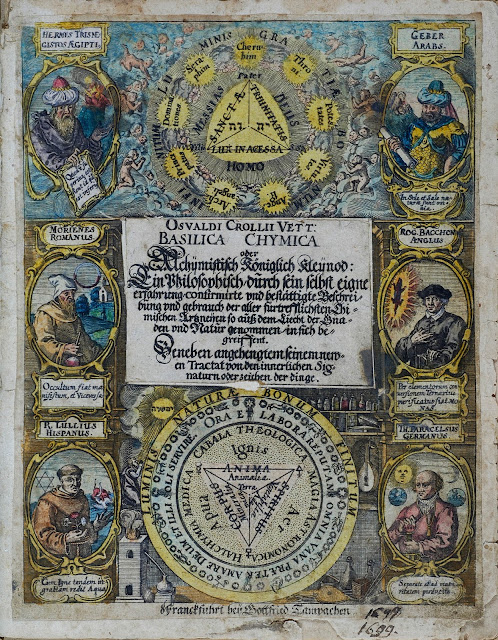
Osvaldus Crollius, Basilica Chymica, Chemical Heritage Foundation, Public Domain


Ludovico Locatelli, Theatro d'Arcani, 1644 edition

The turnover of cash around the druggists' shops was considerable. It is known that two pharmacopoeias existed, one for the rich - full of expensive rarities like 'ambergris', 'bezoar-stone', 'unicorn stone', rubies and gold - and one for the poor, much more modest, almost entirely vegetable. The Fabrica de gli spetiali by Prospero Borgarucci (1566), Valerio Cordo's Dispensarium (1554), Johann Schroeder [1600-1664]'s Thesaurus pharmacologicus, Osvaldus Crollius [1563 - 1609]' Basilica chymica and Ludovico Locatelli's Theatro d'arcani [1644], presupposed buyers with unlimited available finances."
(Camporesi 1996, '5. 'They Rotted in Their Own Dung'', p. 73)


Ambergris

[Ambergris: "a solid, waxy, flammable substance of a dull grey or blackish colour produced in the digestive system of sperm whales. [...] Ambergris has been mostly known for its use in creating perfume and fragrance much like musk. Perfumes can still be found with ambergris around the world. It is collected from remains found at sea and on beaches [...] During the Black Death in Europe, people believed that carrying a ball of ambergris could help prevent them from getting the plague. This was because the fragrance covered the smell of the air which was believed to be a cause of plague. This substance has also been used historically as a flavoring for food and is considered an aphrodisiac in some cultures. During the Middle Ages, Europeans used ambergris as a medication for headaches, colds, epilepsy, and other ailments." (Wikipedia, dd. 26/02/2016)]


Elephant bezoar


Unknown, Goat bezoar, 16th century, Wien, Kunsthistoriches Museum (Kunstkammer)

[Bezoar: " a mass found trapped in the gastrointestinal system (usually in the stomach); Bezoars were sought because they were believed to have the power of a universal antidote against any poison. [...] In 1575, the surgeon Ambroise Paré described an experiment to test the properties of the bezoar stone. At the time, the bezoar stone was deemed to be able to cure the effects of any poison, but Paré believed this was impossible. It happened that a cook at King's court was caught stealing fine silver cutlery and was sentenced to death by hanging. The cook agreed to be poisoned instead. Ambroise Paré then used the bezoar stone to no great avail, as the cook died in agony seven hours later. Paré had proved that the bezoar stone could not cure all poisons as was commonly believed at the time. 
Modern examinations of the properties of bezoars by Gustaf Arrhenius and Andrew A. Benson of the Scripps Institution of Oceanography have shown that they could, when immersed in an arsenic-laced solution, remove the poison. The toxic compounds in arsenic are arsenate and arsenite. Each is acted upon differently, but effectively, by bezoar stones. Arsenate is removed by being exchanged for phosphate in the mineral brushite, a crystalline structure found in the stones. Arsenite is found to bond to sulfur compounds in the protein of degraded hair, which is a key component in bezoars." (Wikipedia, dd. 26/02/2016)]


Unicorn Horn / Narwhal tooth
[Unicorn stone: probably "'unicorn horn' [also known as an alicorn], is a legendary object, [...] many healing powers and antidote's virtues were attributed to the horn of the unicorn. These properties, assumed real since the 13th century, made it one of the most expensive and most reputable remedies during the Renaissance, and justified its use in royal courts. Beliefs related to the "unicorn horn" influenced alchemy through spagyric medicine. The horn's purification properties were eventually put to the test in, for example, the book of Ambroise Paré, Discourse on unicorn [...] Seen as one of the most valuable assets that a king could possess, unicorn horns were exchanged and could be purchased at apothecaries as universal antidotes until the 18th century. [...] The legendary unicorn was never captured, but its symbolic association with virginity made it the symbol of the incarnation of God's Word, innocence and divine power. Belief in the power of the unicorn's horn and its origins persisted from the Middle Ages to the 18th century, when the true source, the narwhal, was discovered. This marine mammal is the true bearer of the "unicorn horn", actually an extended tooth found in the mouth of males and some females." (Wikipedia, dd. 26/02/2016)]


woensdag 24 februari 2016

Bread of Dreams - Digest: '3. Sacred and Profane Cannibalism'

"Marsilio Ficino, son of a doctor, prescribed the drinking of blood drawn from the veins of
adolescents as a remedy for the exhaustion of old age, following a universally adopted usage, in his De sanitate tuenda: 'Thus the good doctors, using blood distilled and refined by fire, are
able to recreate and restore those who are eaten away and consumed, little by little, by the consumptive fever of old age. Now why can we not also, with the same liquid, occasionally restore and almost bring back to vital strength those people who are half dead simply because of old age?
There is a certain ancient and popular opinion that certain old women, whom we call witches, suck the blood of babies to rejuvenate themselves as much as possible; why should our elderly, who find themselves bereft of any other assistance, not likewise suck the blood of a yound boy, of robust strength I mean, who is healthy, cheerful, even-tempered and who has - perfect blood and, by chance, in abundance. Then suck it as would a leach or bloodsucker, from the open vein of the left arm ... and during the waxing of the moon. "
(Camporesi 1996, '3 Sacred and Profane Cannibalism', pp. 44-45)

"In terms of therapeutical characteristics "not all skulls were considered of equal value: Those which are stolen from cemeteries, from people naturally dead, are not valued at all [by druggists and doctors]. But they take singular care to choose those skulls belonging to men who suffered violent deaths, and that, purified and cleansed of all filth, have been in the open air for a few years, like those which justice, for the public infamy of great bandits, exposes in iron cages on the gates of the city to the view of others. The reason why this choice is best, according to them, is that the skull of whoever has passed to the other life by means of a natural death is believed to have none of its innate spirit which has been dissipated in the disease; whereas those which met violent deaths still preserve a part of this spirit and because of such a death this powerful spirit, they say, lies concentrated and nearly hidden inside. This is confirmed by the usnea of the human skull, which (according to Olmonte) is a small plant which, by a seed fallen from the sky, grows in the skull on the nourishing sauce of its alcoholic liquid." [...]"Aqua divina was the name of a distillation from corpses, and not a few doctors 'proclaimed its supreme magnetic virtue'. It was prepared by following this recipe: 'The whole corpse (killed, of course, by a violent death), with bones, flesh and intestines, is separated into tiny pieces, and this done well, every part of the body is ground up, so that nothing remains unmixed. Then it is distilled with favourable results." [...]


Jacopo Berengario da Carpi, De Fractura Cranii, 1651


"The flesh of the mummy mixed with mother's milk was the main ingredient in the preparation of a 'human plaster' manufactured in Carpi by the Barigazzi family, a clan of barber-surgeons from which Berengario emerged, a famous anatomist at the University of Bologna and author of De fractura calvae sive cranei (1518):
'Among the medicines for external use, I have never known the equal of my head plaster, known also as the human plaster, because a notable part of human, or rather mummy, substance enters into its composition. I have always heard from the oldest of my family that the mummy which enters into this plaster must be part of a man 's head, and the mummy is dried human flesh. In Venice I saw nearly intact bodies of such a mummy. From what I learned from my father and also from what I have seen, the old people of our family kept one or more such mummified heads in the house, from which they took certain parts for the preparation of the plaster." [...]

[about the 17th century writings of Alessandro Venturini]: "With a preventive prophylactic aim in mind, or else in curative procedures, hair, menstruum and mother's milk and butter were all utilized. Even more numerous were the 'virtues' to be extracted from the body, starting from the 'marrow of dead bone', to 'human fat', blood, the dried flesh of mummies, the excrement and urine of men and
boys, sweat, the 'filth of the ears', the 'mucus of the nostrils', the dirt to be found around the neck of a man's penis' (to be spread on a scorpion sting), and 'testicles given in powder to the woman after menstruation' to make her conceive, according to the recipe attributed to Trotula da Salerno (eleventh century). From the druggists' and herbalists' workshops came ointments, pomades, elixirs, syrups, pills and electuaries: products not dissimilar, in their 'repugnant' composition, from the philtres and ointments attributed to witches."
(Camporesi 1996, '3 Sacred and Profane Cannibalism', pp. 45-48)

Bread of Dreams - Digest: 'Introduction'

"meanwhile, at the lower level of 'civil' society - in the subordinate world of instrumental and 'mechanical' beings, tyrannized by their daily use of 'vulgar breads', in which the mixture of inferior grains, often contaminated and spoiled by poor storage, or, as happened not infrequently, mixed (sometimes deliberately) with toxic and narcotic vegetables and cereals - the troubled rhythm of an existence verging on the bestial contributed to the formation of deviant models and delirious visions. [...]
Among the most common and popular foodstuffs that permitted the transition from a human condition on the verge of the unliveable to a drugged and paranoid dimension was poppyseed bread (the poppy was cultivated in vast areas of Europe with what today would be called industrial methods). It was a bread disguised and flavoured, and in addition spiced with coriander seeds, anise, cumin, sesame-seed oil, [...] In areas where it was cultivated, even the flour of hemp-seeds was used in the kitchen to prepare doughs and breads which 'cause the loss of reason' and 'generate domestic drunkeness and a certain stupidity'. One could doubtless regard this as having been directed not so much from above (as is somtimes supposed), as desired and sought by the masses themselves, consumed as they were by disease, hunger, nocturnal fears and daytime obessions.
The collective journey into illusion, [...] helps to explain the manifestation of collective mental delirium, of mass trances, of entire communities and villages exploding into choreal dancing. But it could also be the path which allows us to catch a glimpse of a two-sided mental model of the world [...] where the layers are overturned, the universals reversed, the world ending up head-over-heels, with head on the ground and feet in the air. The result of an altered measuring of space and time, based on a non-Euclidic geometry and a magical, dreamlike perspective [...].
The spectre of this vampirish society of people possessed becomes visible, fleeing the painful recognition of the brevitas vitae and the fear of death, while trying desperately and cruelly to prolong life by sucking young blood, opening and closing the veins of its own and other's bodies. This society is possessed by a corporeal culture neurotically sensitive to the internal circulation of the humours and convinced of the absolute primacy of good human blood [...]
The purging of the blood and the ridding of impurity [...] were the decisive moments of every therapeutic activity based upon the expulsion of corruption and evil [...] if the blood is not purged, it causes lycantthropy and fears and ugly thoughts, such that one sees men rave and become spellbound in foul and filthy places, among graves and corpses, becouse the infected spirit desires things similar to itself.'"

heks met incubus

"Seen from this perspective, the image of a febrile and sleepless society comes into view, attempting to resist the nocturnal visitations, the presence of the night-dwellers (incubi [demons in male form who lie upon women in order to engage in sexual activity with them, what may result in the deterioration of health, or even death], goblins [evil grotesque dwarf-like daemons], vampires, witches and werewolves), and to protect itself from the painful aggression of the dreadful and horrible dreams by means of a whole magical pharmacology that induced forgetfulness and serenity [...]."

Wormwood / Absintalsem (Artemisia Absinthium)
Wormwood / Absintalsem (Artemisia Absinthium) 

["Wormwood / Absintalsem (Artemisia Absinthium): Aan de knoppen van Absintalsem wordt vanouds een geneeskrachtige werking toegeschreven. Het bittere aftreksel van deze knoppen vormt een belangrijk bestanddeel van de dranken vermout en (klassieke) absint. De smaakstoffen die daarbij een rol spelen zijn absinthine en het naar menthol ruikende terpeen thujon. Zoals alle alcoholhoudende dranken, kan absint bij langdurig en frequent gebruik leiden tot verslaving en zenuw- en hersenbeschadiging." 
(Wikipedia, dd. 22/02/2016)]


"Wormwood for example (Artemisia Absinthium)[...] was considered the mother of all herbs [...] from which all others descended as offspring. 'A medicinal herb', of entirely feminine virtue, many call it the matricaria, especially women, for whom it is itself a treasure. They use it with cheese, eggs, etc., to make tortelli during the feasts for Holy Mary [... ] [a] regulator of the female cycle (and because it was governed by the moon), protector of the reproductive organs and feminine fertility, the matricaria [...] was associated [...] with the supernatural power of the mother of the Omnipotent, and then reconsecrated in the Christian baptism of herbs with the Virgin's name. It was ritually eaten as a food filled with enigmatic powers (in their form, too, these stuffed tortelli resembled a half-moon), on the day when it emanated the greatest therapeutic energy. [...]"


tortelli 

"The cuisine of the imaginary, dream-inducing diet, sacrilegious gastronomy (cannibalistic, vampirical and dung-eating), human ointments and plasters, profane oils and sacred unctions, 'mummy' fragments and cranial dust, medicinal powers de sanguinibus, breads filled with seeds and powders bestowing oblivion, expansive and euphoria-producing herbs, narcotic cakes, stimulating roots and aphrodisiacal flours, aromas and effluvia of devil-chasing plants and anti-dotes for melancholy (balneum diaboli), and 'seasoned' and 'fostered' spells created a network of dreams, hallucinations and permanent visions. [...] It was observed how real massacres and imaginary battles, wild warriors and avenging angels were 'depicted in the air', because [...] 'nature is wise and devilish' and 'future things are foreseen in the air'. An aerial theatre that prefigured to men 'signs' of things to come: a symbolic reading of the future conducted with eyes raised upwards. [...]"

Jheronimus Bosch, Hooiwagen-triptiek, zijpaneel links, ca. 1515, 136 x 45 cm, Madrid, Museo Nacional del Prado, cat. 13

Pieter Bruegel, De aartsengel Michaël in gevecht met de apocalyptische draak, 1562, 117 x 162 cm, Brussel, KMSK, inv. 584

"The people of the town and city as well; lived immersed in a world of expectation, in a suspended and bewitched condition, where portent, miracle and the unusual belonged to the realm of the possible and the everyday: the saint and the witch (in her own way, a saint of a different type) reflected the two ambiguous faces, the face side and reverse of the same neurotic tendency towards the separation from reality, the voyage into the imaginary and the leap into the fantastic. [...] The saint - eccentric wizard of ecstasy in a body consumed by penance and privation, his mind altered by fasts, like certain hermits kept alive by roots and herbs (but which ones?) - was equipped with shamanistic powers (trance, levitation, knowledge of the language of animals...). The 'immeasurable treasure of most holy poverty' possessed by the father of the Fraticelli produced the same effects of an upsetting withdrawal from reality, and in the process stimulated the same sense of the real and the impossible, as experienced by those who, suffering and subdued by an involuntary poverty, victims of an alienating indolence, fell into shocking hallucinations and stupefied contemplations of unreal worlds. [...]
In Florence during November l509, a wandering charlatan known as 'the Spaniard' - who often climbed up on to a bench to sell his prayers following his text with an example, like a good preacher - began his market-performance of the supernatural in this way:
'In order that you will believe that this comes from a saint who performs miracles, and that what I tell you is true, come and lead me to a hot baker's oven, which I will enter with this prayer.' And so he was led to this oven, at the Holy Trinity, with the people behind and many of the leading citizens ... On arrival at the baker's he said: 'Give me some uncooked bread' and threw it in the oven to show that it was hot, and then he stripped down to his shirt and dropped his trousers to his knees, and in this way he entered till high up, and stayed there awhile, and picked up the bread and turned around inside. And note, the oven was hot, he brought out the bread, and he didn't harm himself at all. When he had got out of the oven, he was given a torch and he lit it, and lighted as it was, he put it in his mouth and kept it there until it was extinguished. And many other times on the bench, over the course of several days, he took a handful of lighted tapers, and held up his hand for a length of time, and then he put them burning into his mouth, so that they went out. And he was seen to do many other things with fire: raising his hands into a pot of oil that was boiling on the fire, was seen many times by all the people. And thus he sold as many of the prayers as he could make; and I say that among all the things I have ever seen [the observer is Luca Landucci, a Florentine spice merchant] I have not seen a greater miracle than this, if it is a miracle. [...]
The boundaries between the real and unreal, possible and impossible, sacred and profane, abstract and concrete, holy and cursed, purity and filth, and idecency and sublimity are extremely fleeting and uncertain. [...]"

"Western Europe, at least until the seventeenth century, has the appearance of an enormous house of dreams where the diurnal regime becomes confused with the nocturnal, and which is master of surrealistic mythologies [...]. The Europe that, as Jacques Le Goff has splendidly perceived, turned repeatedly to 'agents of oblivion' more than to the professional witch, domina herbarum et ferarum, and that had the first innovators of the artificial delights and narcotic sweetness accompanying a concocted and directed diet of dreams in the women of the home: the mothers, grandmothers, aunts, godmothers, the wet-nurses who nursed the infants, and the domestic casters of charms.
At least until the end of the eighteenth century the habit of administering an infusion of poppies steeped in water to slightly restless children survived in the Italian countryside. This custom was widespread in France as well, since Josephe Raulin, towards the middle of the eighteenth
century, described as 'always suspect the narcotics which ... all too commonly are given to children to calm them', and the celebrated author of the 'Avis au peuple sur sa sante' (1760), the Lausanne doctor Samuel André Tissot, recognized that 'les remèdes tirés de l'opium ... sont d'une absolute necéssite [aux enfants].' [...]"

Black Nightshade / Zwarte Nachtschade (Solanum Nigrum/Hortense)
 
Black Nightshade / Zwarte Nachtschade (Solanum Nigrum / Hortense)), Leonhart Fuchs, De historia stirpium commentarii [...], Basileae (In officina Isingriniana), 1542, Renaissance Herbals /Smithsonian Libraries

["Solanum Hortense [nachtschadefamilie cfr tomaat, aubergine, aardappel etc] was a traditional European medicine used as a strong sudorific, analgesic and sedative with powerful narcotic properties, but was considered a "somewhat dangerous remedy." 
(Wikipedia, dd. 22/02/2016) 
"De niet meer in gebruik zijnde naam Hofnachtschade - bij Dodonaeus [Rembert Dodoens (1518 - 1585)]Hofnascaye - behoeft wel enige nadere toelichting: uit de naam Hofnascaye is op te maken dat de plant in de tuin of het hof gekweekt wordt. We laten hier Dodonaeus aan het woord: ‘Onder de geslachten van Nascaye oft Solanum is het eerste en gemeynste Tam, dat wij in dit Capittel beschrijven sullen: de andere zijn wilt.’ Boven de [...] afbeelding staat als benaming ‘Tamme oft Hof-Nascaye.’ Hij noemt haar dan ook Solanum hortense. Hortense beduidt in de tuinen gekweekt. De woorden Tam en Hof duiden erop dat zij gekweekt werd, maar merkwaardigerwijs vermeldt hij dit niet. Ook niet dat zij vroeger gegeten werd, hoewel hij de geschriften van Dioscorides [ca. 40 - 90 na Christus] wel degelijk kende. Deze laatste noemde de plant Strychnos en schreef dat zij als salade gegeten werd. In de tijd van Dodonaeus was de plant reeds uit de hoven ontsnapt en wijd verspreid want, deelt hij mede, ‘Nascaye wast op veel verscheyden gewesten, niet alleen in de hoven, daer het den naem Tamme oft Hof-nascaye voert, en daer het dicwijls onder ander cruyden vermengt pleegt te groeyen, maer oock wel neffens de wegen, aen de canten van de velden ende bouwlanden, bij de hagen ende heggen, omtrent oude muren ende weegen, vervallen huysen ende puynachtige steenachtige oft rouwe gruysachtige plaetsen.’ Volgens Valerius Cordus en K. Gesner (zestiende eeuw) werd zij in die tijd nog aangeplant en als groente genuttigd. Hierbij valt op te merken dat, volgens ons, niet de giftige bessen werden gegeten maar alleen de bladeren." (H. Kleijn , Planten en hun naam, 1970) "Solanum: is afgeleid van het Latijnse solari = pijnstillen, kalmeren of tot bedaren brengen, vanwege de pijnstillende werking van enkele soorten van het geslacht. Nigrum: duidt op de zwarte kleur van de bessen. Zwarte nachtschade: de bes is zwart, daaraan heeft ze het eerste deel van haar naam te danken. Het woord nachtschade komt van het middeleeuwse woord nachtschaduwe. Vroeger dacht men dat de plant toverkracht had en nachtmerries verdreef." 
(F. Kok, Waarom brandnetel?, 2007) (Etymologiebank, dd. 23/02/2016)]

"In the seventeenth century the botanist to the Grand Duke of Tuscany, Paolo Boccone, a tireless traveller, noted that the women of Moravia 'in order to induce sleep in babies who cry in the cradle or in bed, place beside the baby a bunch of solanum hortense, upon which the baby quickly quiets down and falls asleep. The cause of this effect must be attributed to the narcotic effluvia, and also because the pores of the babies are susceptible and they are more capable of receiving the effect of these plant effluvia than adults. The belief that the emanations and effluvia of the volatile aromas and essences passed rapidly through the pores of the skin and were absorbed almost instantaneouslywas one of the commonplaces where learned knowledge and peasant doctrine coincided perfectly. From Albertus Magnus, who believed that the effluvia of opium, thorn-apple and crocus could be absorbed even at a distance, it passed to Ambroise Paré, who none the less took a critical position on this matter in De vulneribus sclopetorum, and to Fallopio, Fioravanti, Cardano (of the De subtilitate), and Robert Boyle, author of a singular Tentamen porologicum, who (as in another of his works, the Specificorum remediorum concordia cum corpuscolari philosophia) not only upheld the therapeutic benefit of wearing medical substances hung from the neck, but solemnly declared to have been cured
of a haemorrhage simply by holding in his hand moss taken from a human skull.
In this general faith in the simultaneous absorption through the skin's pores, the greases, oils, ointments, plasters and poultices occupied a privileged position in the transmission of pharmacological messages, both harmful and beneficial. [...]
Society of old was made up of a swarm of people, oiled, smeared, anointed and spiced, violently odorous and unbearably smelly, where everyone was in turn anointed and anointer, and where the sense of smell dominated heavily[...]."


"In this regard at least, Campanella's City of the Sun is not at all utopian, resembling rather a normal report on the customs of an ordinary European city:
'They eat what is most beneficial and suitable according to season ... The Solarians make great use of fragrances ... [they] chew some marjoram, parsley, or mint and rub it on their hands. The folk use incense ... they often wash their bodies with wine and aromatic oils ... they observe the stars, inspect herbs ... they use prayers, fragrances, head comforters, sour things, gaiety, and fatty broths sprinkled with flour. In preparing tasty dishes that are a delight they have no equals. They make great use of mace, honey, butter, and many aromatic herbs ... they know a secret, marvellous art by which they can renew their bodies painlessly every seven years.'"

Mandrake/Alruin (Mandragora Officinalis)
Mandrake/Alruin (Mandragora Officinalis)


(nachtschadefamilie): De alruinwortel bevat giftige alkaloïden (scopolamine, atropine, apoatropine, hyoscyamine, cuskhydrine, solandrine, mandragorine en andere hallucinogene tropaanalkaloïden). De plant werd vroeger als narcoticum en pijnstiller, en deels ook als hallucinogeen middel gebruikt, onder meer in heksenzalf." 


Henbane/Bilzekruid (Hyoscyamus Niger)


["Henbane/Bilzekruid (Hyoscyamus Niger) (nachtschadefamilie): De gehele plant is zeer giftig. De belangrijkste gifstoffen zijn de zogenaamde tropane alkaloïden scopolamine, hyoscyamine, atropine. De vergiftigingsverschijnselen zijn een opgezwollen buik en hevige krampen. Hierop volgt eerst verlamming en ten slotte de dood.In de volksgeneeskunde werd deze narcotische (pijnverdovende) en hallucinaties opwekkende plant als krampoplossend middel en bij astma ingezet. De bladeren, en ook de gemakkelijker doseerbare zaden, werden voor hun roesopwekkend effect gerookt. Tot in de 17e eeuw werd bilzekruid gebruikt als smaakstof voor bier." 
(Wikipedia dd. 22/02/2016)]


(Black) Poppy (Papaver Somniferum)


["(Black) Poppy / Papaver (Papaver Somniferum) produces edible seeds and is also the source of the crude drug opium which contains powerful medicinal alkaloids such as morphine and has been used since ancient times as an analgesic and a source of narcotic, medicinal and recreational drugs." 
(Wikipedia, dd. 22/02/2016)


Poplar / Populier (Populus) 

["Poplar / Populier (Populus): De binnenbast van de (zwarte) populier kan gegeten worden. De bast kan gedroogd en verpoederd worden zodat het een meel wordt. Van dit meel kan een brood worden gebakken. Het is noodvoedsel. Galen of Galenos von Pergamon, een arts uit het oude Griekenland meldde reeds een medicinaal gebruik van de knoppen van de bloemen van de zwarte populier. Deze worden gebruikt ter pijnbestrijding. Ook vandaag de dag kunnen we de knoppen van de zwarte populier tegen komen in een pijnstillende balsem." 
(Mens en gezondheid, dd. 22/02/2016)] 


"In this aromatic world of sensitive skin and magnetic pores, in order to prevent nursing infants from falling victim to 'terrifying dreams', 'hideous dreams', and 'fantasies' that 'by inciting dreams disturb the sleep', the wet-nurse, for her part, had to maintain a strict diet, eating 'lettuce in broth or in boiled salad and poppyseeds: sedative substances that were transmitted to the infant along with the milk. And furthermore, every night the anointing ritual took place beside the cradle: the infant was smeared from one temple to the other with a poplar ointment [in which poplar buds were mixed with black poppy, mandrake and henbane], rancid oil and a little opium, and a bit of vinegar, spreading this on the nostrils as well. A more effective remedy', advised the Roman doctor Scipione Mercuri, who died in 1615, 'is to boil lettuce seed and white poppyseed, with a little saffron and vinegar, in the rancid oil, spreading this over the temples with a cloth. A small amount of white poppy syrup taken through the mouth will also help. '
Thus prepared and 'seasoned', the infant was entrusted to the dark arms of the night. The initiation into controlled dreaming and the artificial ease of opium-induced sleep began with swaddling clothes. From infancy to old age narcosis ruled supreme."
(Piero Camporesi, 'Introduction', Camporesi 1996, pp. 17-25)